

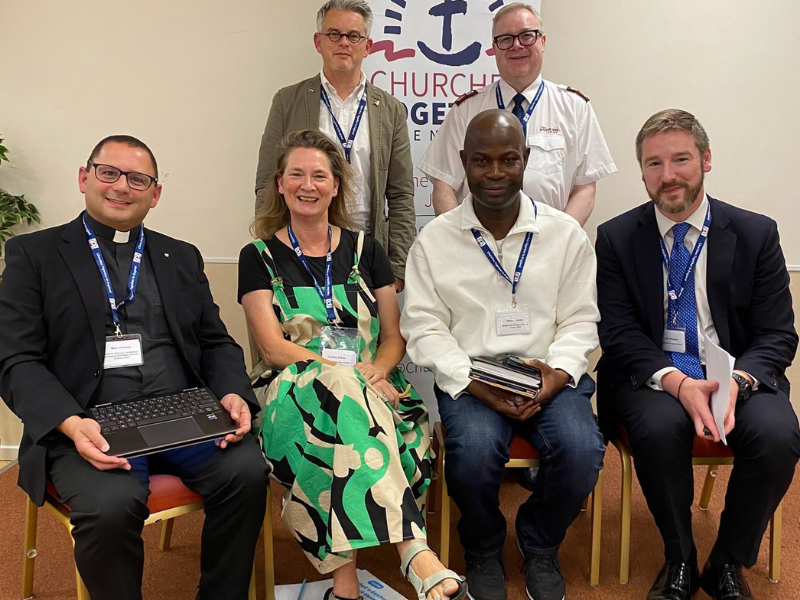
Ecumenical officers from across England gathered at The Hayes Conference Centre in Derbyshire at the end of September to consider what “Belief, Identity and Belonging” look like from an ecumenical perspective.
The event, organised by Churches Together in England, takes place annually, and also welcomes United Reformed Church representatives from Scotland and Wales. It is a unique opportunity to bring together people who live out ecumenism on the ground, says the URC’s Head of Ecumenical Relations and Evangelism, Lindsey Brown. She notes that of the 100 conference participants, the largest contingents were from the URC and the Methodist Church, who work closely together in nearly all of the URC’s Local Ecumenical Partnerships (LEPs).
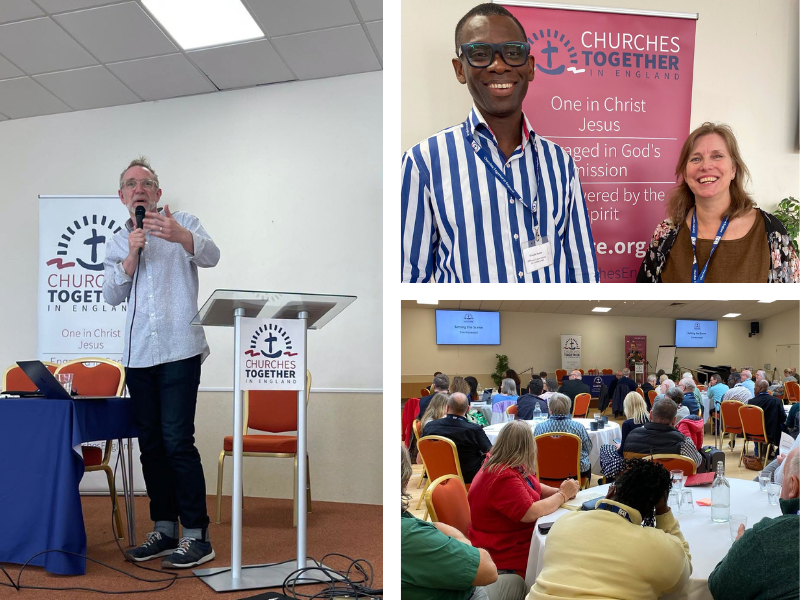
Reflections on Christian Nationalism were an important focus over the three days, and what organisers called “the idolatry that places nationhood above our prime task of building the Kingdom of God, and the impact this has on the lives of many in our communities”. Speakers included singer, poet and Executive Director of Christians in Politics, Andy Flannagan (below left), who shared his personal experience of division and disorder in Northern Ireland driven by political and religious conflict. “The current Northern Ireland experience of conflict focussed on Orange Order marches is all part of the Christian Nationalism debate,” Lindsey argues, “and is an example of how costly such disagreement is for communities.” From their own experience in Essex and East London, ecumenical officers Claude Halm and Claire Barford (below right) also emphasised the value of engaging with CTE’s resource Kingdom Over Nation.
Lindsey says that alongside presentations, it is the conversations between ecumenical officers working locally and across wider areas that are so valuable, and the awareness that fruitful cooperation is achievable even among those whose theology or approach to evangelism, for example, may be quite different. She speaks of the single-congregation LEP of Bar Hill in Cambridgeshire, which has been embedded in the community since new housing was established there in the 1960s and continues to retain strong working relationships across six denominations. At the same time, ecumenical collaboration doesn’t always run smoothly. A gathering like this can address ways of responding when local contexts are challenging. Lindsey herself spoke as part of a panel on ecumenism and evangelism (main image), sharing that the URC itself has moved its ground over the last few years, more easily embracing different approaches to evangelism and developing resources for pre-evangelism.
“It was good to be reminded how God is in all these different perspectives,” says the Revd Jenny Mills, the URC’s Deputy General Secretary (Faith in Action), who was attending the event for the first time. She was struck not only by how much the URC’s own ecumenical officers are doing on the ground – the connections they make and their level of commitment – but also by the value found in experiencing different ways of talking about, and worshipping, God.
“Your parameters are stretched by engaging with other traditions and perceptions. The variety of experience, possibility and commitment people have just shows the vastness of God and how encounters can be transformational and uniting at the same time. It just makes you go ‘Wow!’”