

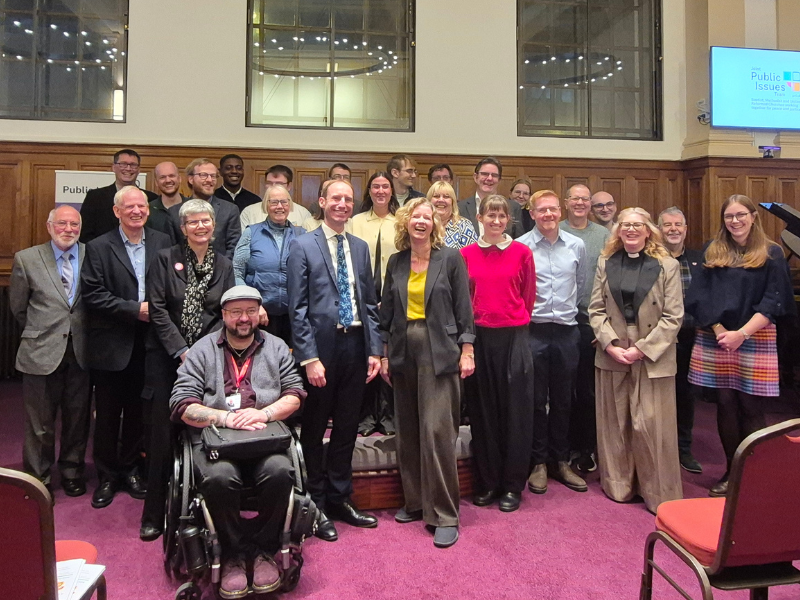
Friends and former and current members of the Joint Public Issues Team (JPIT) gathered at Methodist Central Hall in Westminster on 2 November to celebrate the partnership’s 20th anniversary.
Formed in 2006, the partnership brought together the Baptist Union of Great Britain, the Methodist Church and the United Reformed Church, to work together for peace and justice through advocacy, political engagement and witness in the public square. In more recent years, the team has also formed partnerships with the Church of Scotland and the Iona Community.
Around 70 people attended the service, where attention was drawn to past and present campaigns and resources.
One of the highlights was hearing from former interns about what they had enjoyed most about working with JPIT and how the experience had served as a launchpad for careers in the charity and political sectors. Some have also gone on to serve in ministry.
Special guest Lucy Berry, who was for a time the team’s poet-in-residence, performed her poem “Ideas, like Doves”, originally written during JPIT’s 2018 conference.
The service included a specially written hymn by Steve Tinning, the Baptist Union’s Public Issues Enabler, set to the tune of Ode to Joy. Team member Paul Morrison led the congregation in an ‘Affirmation of faith in an age of division’. Prayers were led by Katherine Fox, Chair of JPIT Strategy & Policy Group, and a blessing was given by the Revd Jenny Mills, Deputy General Secretary (Faith in Action) for the United Reformed Church.
Reflecting on Micah 6:8, guest preacher Bishop Mike Royal, General Secretary of Churches Together in England, spoke about the Church’s responsibility to be an active presence in the struggle for justice, rather than simply a place of worship or a provider of charitable support. He challenged churches to use their public voice, stand alongside people experiencing injustice and help address the structures that cause inequality.
He spoke about the importance of churches working together across denominational boundaries, rather than retreating into their own traditions or keeping their heads down in difficult times. The Church, he argued, is called to support and amplify the voices of people who are marginalised and oppressed, rather than speaking on their behalf. He also highlighted the need to challenge Christian nationalism and the ways in which Christianity can be used to divide communities, particularly around questions of religious identity, migration and people seeking refuge.
Drawing on his experience of community work, Bishop Royal stressed that responding to immediate need is not enough: churches must also challenge the reasons people find themselves in difficulty. He used Desmond Tutu’s image of stopping pulling people out of the river and instead finding out why they are falling in.
“That means tackling structural inequality, developing policy from the ground up and ensuring that people affected by decisions have a voice in shaping them” he said. Bishop Royal also emphasised that the legacies of the transatlantic slave trade and the demands for reparative justice are not simply historical issues, but matters of continuing injustice.
Finally, he reminded those involved in justice work of the need to sustain themselves spiritually and emotionally, making time for prayer, reflection and rest so that they can serve from a place of strength rather than exhaustion.
Roo Stewart, Head of Public Issues for the URC, explained how important the partnership is for the URC.
“As a relatively small denomination, it can be easy for our voice, our concerns and our passion for justice to be overlooked and unheard in the public square. By joining with others who share similar views on how a flourishing society should function, this vibrant team represents us carefully and prayerfully, ensuring that we can respond usefully and prophetically,” Roo said.
“JPIT is known as a trusted source of information that is up to date and focused on shared Christian values.
“For me, one of the most significant impacts we have had on society in the last few years is the ending of the ‘two-child rule’, where children whose families received Universal Credit were not allowed financial support if they had two or more siblings. We had been campaigning on this issue for several years, in coalition with anti-poverty charities, and coordinated over 40 faith leaders to press the government about this in 2025. The government finally ended this unfair policy in April 2026.”
JPIT’s first team leader, Alison Jackson, said: “It was really good to be in at the start of all this. It’s developed an awful lot since I moved on, but I think it’s an absolutely fantastic resource for the churches. I hope it continues to tackle all the difficult issues and to help churches understand and deal with them.”
Reflecting on the anniversary, current team leader Simeon Mitchell said: “It was brilliant to bring together all the people who’ve been involved in JPIT over the years and to celebrate together and to reaffirm our commitment to doing this work.”
Keep up to date with news from JPIT by signing up to its newsletter.
JPIT’s weekly podcast – Politics in the Pulpit – enables preachers and worship leaders to prepare services and sermons that respond to current affairs and politics in the light of the Revised Common Lectionary readings for that Sunday. And our Justice Weekly prayer pointers support personal and corporate prayers and intercessions based around the UK Parliamentary agenda and public issues in the news each week. Tune into Politics in the Pulpit.