

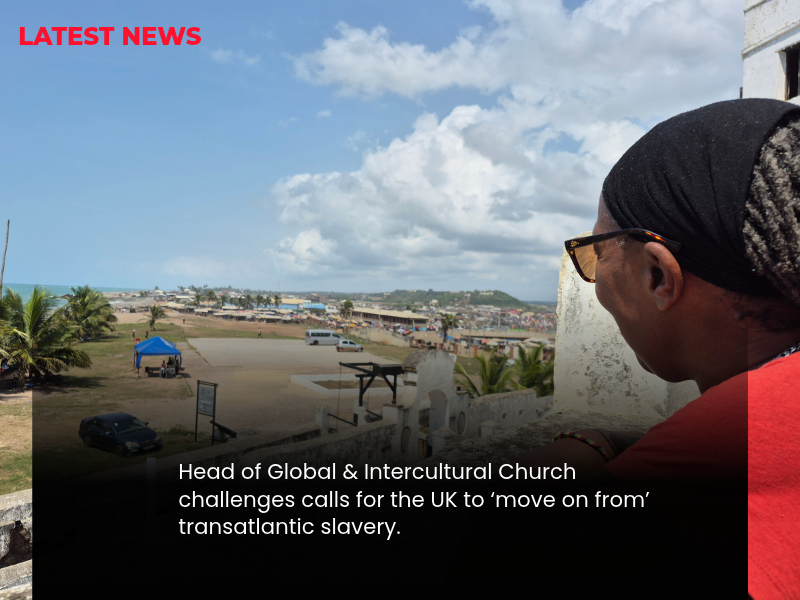
Karen Campbell, the United Reformed Church’s Head of Global & Intercultural Church, appeared on Premier Christian Radio on 5 November challenging calls for the UK to ‘move on from’ transatlantic slavery.
Although contrition was expressed, Karen’s comments came after language used by King Charles at a summit in Antigua suggested that chattel slavery belonged firmly in the past. He referred to what the UN deemed in March to be the gravest crime against humanity, as “a shameful chapter of history”, signalling that an improved relationship on trade and investment is needed instead of reparations, which Prime Minister Andy Burnham has also ruled out.
Across the political spectrum, Kemi Badenoch, leader of the Conservatives, has said that the Commonwealth “should be looking forward, not endlessly backwards which she called a “navel-gazing distraction” and back in April, Reform UK said it would deny new visas, including visitor visas, to people from countries seeking slavery reparations from Britain if it formed the next government.
Karen said the whole point about the call for reparations is that “it’s not just about history, it’s about the continuing legacies of slavery today”.
“People want to say it’s time we get over it. It’s time we move on. And my question is, how do people move on unless they are equipped to move on? And how do they become equipped to move on when what they need has been stripped away from them and is benefiting other nations, including the UK, instead of benefiting the nations who need to move?”
Taking Jamaica as a specific example, 30% of the population is classed as squatters. Karen called this a clear legacy of transatlantic slavery, “which is not just about the past, but is very much in the present”.
The URC is working with the Churches’ Reparations Action Forum (CRAF), Jamaica, on a transformative housing initiative which will see historic Churches in Jamaica donate land inherited after slavery and colonisation while global partners support the building efforts. The vision is to create sustainable communities, with homes and small plots of land enabling residents to grow food and generate income. The partnership developed after a statement of confession and apology was made by the URC for the role of its antecedent bodies in transatlantic slavery, which was accepted by the Jamaican government in 2024. The commitment has also seen the URC raising funds to support relief efforts in the wake of Hurricane Melissa, which caused further devastation to communities already struggling with unstable housing and living conditions.
When asked what “equipping” would like from governments, Karen responded that it should include all the things that the Commonwealth nations are asking for:
“The respectful conversations, the actual listening, the hearing, the efforts to respond meaningfully.”
Making clear that it wasn’t about people today being held responsible for actions in the past, Karen, said “giving back what doesn’t belong to us” should also form part of reparations as the UK’s wealth “has been built on the back of what belongs elsewhere”.
“If I stole something and gave it to my child, if she doesn’t know that it’s stolen, I think that’s one thing — she wouldn’t be expected to give it back. But if somebody comes and shows her that actually the reason why you’ve got that is because your mum stole it from somewhere else, does the fact that it was me who stole it mean that she mustn’t give it back? I would say not at all.
“She must give it back.”
Karen highlighted three biblical texts to support her position: the Israelites being released from Egypt, taking with them all kinds of gold, silver and jewellery.
“It wasn’t about what the Egyptians released on the Egyptians’ terms,” Karen said. “It was about what the Israelites were able to take by way of compensation and to set them up for the next chapter.”
The second text was the story of Zacchaeus, the tax collector, who had cheated people.
“When Zacchaeus did his paying back, he not only repaid what he had taken wrongly, he also repaid what I think was fourfold to those who he had cheated. It wasn’t just giving back what he took, it was giving back with interest; a recognition that had I left it with you in the first place, you could have built on this. You could have built your life. You could have been earning interest somewhere else. You could have been setting yourself up, but I robbed you of that. So now I’m giving it back to you so that you can start over. Probably not in the same place as if I hadn’t cheated you, but you can start over from a place of good sense, from a place of possibilities.”
The third reference was to scriptures in Corinthians about the body of Christ – “If one part hurts, all parts hurt”.
“We say these words in a churchy setting,” said Karen. “But then when it comes to reality, do we actually practice it?
“As far as I can see, some parts of the body have been hurting for a long, long time. They’re crying, they’re weeping, they’ve been struggling. Somehow, they’re permitted to keep on struggling – and we keep going in the ways that we keep going. So, when are we going to put that into practice?”
Listen to Karen’s interview in full.