

The 2026 meeting of the United Reformed Church General Assembly continued at The Hayes Conference Centre in Swanwick.
Bible Study
Today’s Bible study was led by the Revd Dr Peter Green, Dean of Chapel at Lincoln Bishop University. He looked at the story of Melchizedek in Genesis and Hebrews, where Abraham meets Melchizedek, the priest-king of what will be Jerusalem, and is given bread and wine.
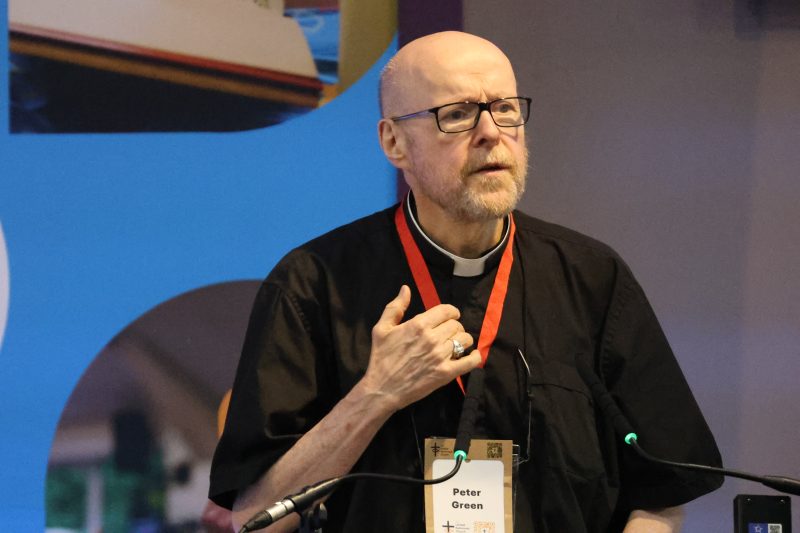
Dr Green asked, Who are we, the ordinary people, in this story? His answer was: We are in the loins of Abraham, as his descendants by faith. And what are we to do? If we ordinary people have faith we will do extraordinarily good things. Faith is an action.
“In my tradition,” he said, “all baptised people are members of the common priesthood; we all stand between each other and God. We can bring each other into the presence of God – or we can stand in their way.”
Session three
Paper A3 – Resource Centres of Learning – Education for Ministry Phase 1 (EM1) Review [presentations session]
Proposals were brought to Assembly about the future of the Resource Centres for Learning (RCLs, formerly known as “colleges”) in relation to Education for Ministry Phase 1 (EM1). EM1 refers to the training undertaken by those wishing to enter ordained ministry (of Word and Sacraments or as Church-Related Community Workers). Currently URC students train at one of three RCLs: Westminster College, Cambridge; Luther King Theological College, Manchester; Scottish United Reformed and Congregational College, based in Glasgow.
Assembly 2025 determined that the number of RCLs should be reduced by at least one. Subsequently, a review has been undertaken, leading to the proposals presented to this Assembly. At the heart of Resolution 2 were the proposals that:
- Luther King Theological College (LKTC) becomes the primary RCL for the United Reformed Church, and provider of EM1 training
- Scottish College becomes the complementary RCL for the United Reformed Church, and provider of EM1 training
- Westminster College to ceases as a partner for EM1training
The review addressed declining student numbers, over-capacity in training provision, and financial sustainability in EM1. The review panel agreed with the conclusion of General Assembly 2025 that it is unsustainable to maintain three institutions and that the Church must therefore “concentrate resources to ensure long-term viability; move to a model of sustained partnership with one primary and one secondary institution; and enable the partner institutions to flourish, not merely survive”.
The Revd John Bradbury, General Secretary, spoke on behalf of the Business Committee and the review panel.
He spoke about the importance of theological education in the Free Church and United Reformed traditions, including within the Sunday School tradition. He acknowledged the difficulty of the task in hand but pointed to the difference in numbers of candidates coming forward for training. He compared the figures for 2026 with those in 2006 (the last time the structure of RCLs was reviewed): 13 stipendiary candidates across the three RCLs in 2026 compared with 51 in 2006; and 42 non-stipendiary candidates in 2026 compared with 92 in 2006.
The option to purchase theological education from other providers had been rejected.
There is a desire for students engaged in EM1 to undertake their training with those who are training for other of forms of ministry – LKTC is already particularly well-placed to offer that type of integrated experience. And where LKTC is an example of integrated training derived from individual student pathways, the Scottish College delivers an integrated approach through its programmes, which are themselves rooted in other theological institutions within the Scottish university system. This, the panel observed, allows the Scottish College considerable flexibility.
Dr Bradbury spoke of the angst in making the decision to end the URC’s EM1 partnership with Westminster College, and the pain involved for all concerned.
Mr Alan Yates, the URC’s Treasurer, spoke to the financial analysis within the report. Financial sustainability was only one of ten criteria in the process, he said; nor was a forensic financial investigation undertaken. Financial modelling was based on estimates made through until 2032, by which time LKTC will have undertaken a multi-million refurbishment programme, and the review’s proposals will have been fully implemented.
Mr Yates noted that the average of eight new students estimated per year, assumed in the report and used for the purposes of planning over the coming years, is higher than statistically-generated numbers, and higher than in 2027.
He confirmed that the URC cannot afford to support three RCLs from the Mission and Ministry budget, which is in any case under pressure. With two RCLs, there is a chance of providing the support needed. However, he warned that if student numbers continue on the current downward trajectory, this may not be the last time the URC will need to re-visit its partnership with the RCLs.
Finally, Mr Yates addressed Westminster College’s disagreements with the panel’s financial conclusions. He noted that there was a view that, though Westminster’s financial status might be similar to LKTC’s in 2032, LKTC has considerably more reserves.
The Revd Dr Peter McEnhill, Principal of Westminster College, addressed Assembly on behalf of its governors. He said Westminster’s concerns with report’s conclusions fell into two parts. He said he didn’t believe that where courses are located at present is a good way of assessing what can be provided in the future. He also spoke about the deep and rich collaborations with other ecumenical institutions in Cambridge that are at least comparable with those in place at LKTC. He said that the panel’s conclusions regarding Westminster’s annual £300,000 debt for capital expenditure and the view about grants being obtained in the future were unduly pessimistic. He said that “switching off” EM1 would have complex consequences, including unravelling the relationship with the URC, which he said “owns” the college. Additionally, he asked how the college’s charitable commitments would be sustained in the future. The URC has a commitment of stewardship towards Westminster College, he argued.
The Revd Dr Adam Scott, URC Principle at LKTC, expressed gratitude for the openness of the panel’s approach, acknowledging difficult issues had to be addressed. He said LKTC (formerly Northern College) was in a very different place from a few years ago. He welcomed the confidence expressed in LKTC and Scottish College, which allows for existing collaboration to be extended; but he expressed concern for colleagues at Westminster.
The Revd Dr John McNeil Scott spoke on behalf of the Scottish College. He said collaboration with other RCLs over the period he has been Principal has been transformed (and the contribution of Westminster to it has been substantial and generous). There are structural outcomes that he would have preferred – but he acknowledged that some serious crunch in finance and student numbers was inevitable. He questioned the designation “complementary RCL”, which he said both allays concerns but raises others for the future. But he said the college is confident in what it delivers and in the partnership with the URC first established in 2000; and he committed the college to working positively with LKTC and the Ministries Committee.
Responding to the principals, Dr Bradbury felt the ecumenical balance at Westminster is more weighted towards the Church of England; he said that at LKTC the balance is more evenly distributed between denominations. He said that a lot would require to be developed at Westminster if it were to continue delivery EM1; for example, weekend pathways that serve lay preachers and other forms of ministry. He addressed complex issues of charity purposes and acknowledged these would need unravelling.
Assembly broke at this point and will return for questions and debate on this report on Sunday.
Session four
Community Project Awards 2026
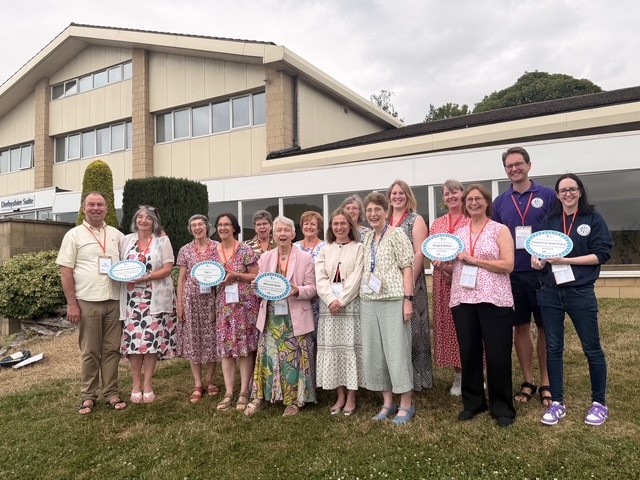
Four local church initiatives were named as winners of the 2026 Community Project Awards, sponsored by the insurance company Congregational, receiving prizes of £2,000 each:
- Children’s and Youth Project at Stag Community Church, Rotherham, a longstanding young people’s work that has become a renewed focus for the church;
- Time 4 Everyone at The Mead Centre at Newport Pagnell URC, Buckinghamshire, a safe space for coffee, craft and food, welcoming people on the margins;
- Songs and Stories from St Andrews URC in Monkseaton, Tyneside, a parents and children’s group providing coffee and cake, and activities based on Bible stories;
- Pop-In project at Broadstone URC, Dorset, a monthly group offering children’s activities and worship.
Additionally, two projects were highly commended, receiving prizes of £1,000 each:
- Welcome Space at Old Meeting Place URC, in Bedworth, Warwickshire, a weekly event for people whose needs include loneliness or a warm place to chat;
- St Arbucks community café from Trinity Church in Market Lavington, Wiltshire, a high street café that serves the community and makes the church visible.
Full reports on all six projects will be published in Reformed over the coming year.
Session five
Presentation of candidates for General Assembly Moderator for 2027-2028, and vote
The Revd Dr Susan Durber was the sole nominee for the role of Moderator of General Assembly, 2027-28. She was nominated by the URC’s South Western Synod.
Susan was invited to address General Assembly. She spoke about her life in Pembrokeshire, Wales (including her “rather good” Welsh cakes!), and about “the other part” of her life, which is defined by her life with the World Council of Churches (WCC). Her faith, as a result of her work and relationships in the WCC across many years, has deepened and broadened, she said.
Susan said she regards the URC as the “order” to which she belongs – her home within the world communion of Churches – but that she has a “desire and inclination to bring people together across all divides”. She would bring to the role of Moderator her “relentless ponderings about how things are in our Church and world”. She said that though it’s a tough time for the Church and the world, “we need not fear being honest about our griefs and losses. Only then may we be honest about what we can do in the world.” She concluded: “I have no need of another role, but if you ask me to do this, I will do it with all the joy and grace I can find. I am at your service, for the sake of Jesus Christ.”
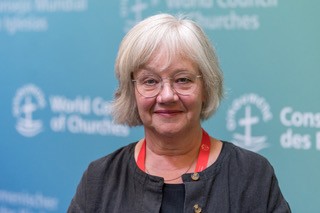
(Photo credit: World Council of Churches)
In response to a question from the Moderator about how the Church might bring joy to a world that gives us so much cause for concern, Susan suggested that it can bring joy because our confidence is in God. She recalled Lesslie Newbigin being asked whether he was an optimist or a pessimist, and replying: “I believe in the resurrection of Jesus Christ.” Susan herself had recently talked to a group of students at her daughter’s school and one lad had said at the end: “I never realised before that being religious could make you happy.” Susan said she was glad to have conveyed some of that joy – which, she added, can be transformative. “Joy is something that erupts unbidden,” she said, “but it can also be chosen.”
Susan has served pastorates in Manchester, Salford, Oxford, Cumnor and Taunton. She was Principal of Westminster College, Cambridge, and played a leadership role within the Cambridge Theological Federation (2007–2013). She served as Theological Advisor at Christian Aid, engaging deeply with issues of global justice, poverty, the environment and development. From 1993 onwards, Susan has played an active part in the World Council of Churches, becoming Moderator of the Faith and Order Commission in 2014; and in 2022, she was elected WCC President from Europe. She is known as a writer and liturgist, including for many publications within the URC.
Following a vote, the Revd Dr Susan Durber was elected as Moderator for 2027-28.
Paper C2 – Sustainability of Stipendiary Ministry in the United Reformed Church
Presented by Mary Thomas, Convenor of Ministries Committee, Paper C2 warns that the sustainability of stipendiary ministry is now at a critical theological and strategic issue. Mary asked the Church to begin a conversation, and posed the question: What does a faithful pattern of ministry in the years ahead look like?
Mary explained that, at heart, the question was a theological question and not one focused on the number of ministers the denomination has. The convenor explained that there are currently around 241 deployable Ministers of Word and Sacraments serving around 1,200 churches, and that these churches are increasingly carried by ministers with multiple pastorates, retired ministers, lay people, and by those going over and above what is sustainable in the long-term.
The paper asks, added Mary, whether ministry needed to be thought about differently, not because stipendiary ministry was less important but because it is so central to the life of the Church, and whether its ecology could be brought together with others – such as CRCWs, Assembly Accredited Lay Preachers, Lay Pioneers, Elders for example – together forming one interconnected pattern of vocation, formation and service.
Assembly was asked to wrestle with three questions:
- What are we actually trying to sustain? Are we simply trying to preserve numbers, or are we seeking to sustain a faithful pattern of ministry?
- What level of stipendiary ministry is the Church willing and able to sustain over the coming decade?
- What would a faithful and sustainable ecology of ministry look like by 2035, and what do we need to begin doing now to move towards it?
Assembly then discussed the three questions and fed back to the convenor.
During the discussion phase, Assembly members welcomed the report and reflected on the future of ministry, leadership and vocation across the United Reformed Church.
The Revd Anne Sardeson, Eastern Synod, said the paper encouraged honest conversations and offered hope to churches that may feel weary or uncertain about the future. The Revd George Watt, Moderator of Thames North Synod, urged the Church to think “outside the box”, suggesting that traditional approaches to ministry may be limiting opportunities for new forms of leadership. The Revd Helen Everard, Wessex Synod, called for greater recognition of the role of elders and lay leadership, while the Revd Dr Michael Hopkins, Moderator of Wessex Synod, encouraged the Church to renew its focus on encouraging vocations and to consider a broader understanding of local church leadership, rather than assuming every congregation requires the same model of ministry.
Responding to the discussion, the Revd Nicola Furley-Smith, Deputy General Secretary (Ministries) said responsibility for nurturing vocation belongs to the whole Church, not solely those overseeing ministries, and indicated that further work on vocation and calling is already underway. The Revd Jenny Mills, Deputy General Secretary (Faith in Action) highlighted existing resources, including conversation starters on vocation, which are available through the URC Learning Hub, alongside new training modules and work to develop elders’ training.
Referring to the 50th anniversary of her ordination, the Revd Dr Elizabeth Welch, former General Assembly Moderator 2001-02, questioned whether the Church places enough emphasis on what the URC stands for today, and what the denomination offers, either in contrast to or alongside other Christian traditions. Elizabeth asked how the Church can dig enough into that vision to encourage the Church to grow to inspire new generations, or is it coming to an end? Louise Sanders, Northern Synod, encouraged a more holistic approach to discernment for ministry, arguing that academic qualifications alone should not determine someone’s calling.
Drawing on the experience of the United Church in Jamaica and the Cayman Islands, Janet McConill, Deputy General Secretary and CWM Mission Secretary, described how her denomination is exploring team ministry as a response to similar challenges around sustainability. She suggested that ministers of the future would need greater skills in leading and developing teams of ordained and lay people, requiring changes to theological education and congregational understanding of shared ministry.
Following further comments, Mary acknowledged that the Church is already grappling with many of these issues, including how ministers are prepared for increasingly collaborative forms of leadership. While recognising the challenges ahead, she expressed confidence that the URC has a distinctive contribution to make and reaffirmed the denomination’s commitment to equipping those called to ministry through appropriate training and support.
Paper C3 – A Three-Year Review and Strategic Framework for Ministry [2026-2029]
General Assembly instigated a review of learning and formation across all accredited ministries in the United Reformed Church, to bring proposals to the 2029 Assembly.
Bringing this resolution to General Assembly, the Ministries Committee argued that ministerial formation should be understood as a single interconnected ecology rather than a series of separate pathways. Different roles in Church life are part of one shared system of discernment and learning.
The committee is inviting the Church to consider the theological purpose of accredited ministry, the nature of different ministries within a shared ecology, standards required for trusted ministry and pathways for lifelong learning.
Introducing the resolution to Assembly, Mary Thomas, Convenor of the Ministries Committee said that it was an opportunity to consider carefully, prayerfully and strategically how Church supports those in whom it discerns a call.
Points that arose during debate included the need to listen to the world Church on this subject as well as ecumenical partners, and the need to consider what it means to minister specifically in a Reformed Church.
The resolution was carried.
Paper D1 – Resources Committee
The General Assembly noted the Annual Report and audited accounts for 2025. These can be read on the General Assembly papers page on the URC website.
Paper D2 – Investment Committee becoming a Sub-committee of Resources Committee
The General Assembly passed three resolutions that were a “simple piece of governance housekeeping with the demise of the Pensions Trust following the [pensions] buyout,” explained Michael Hopkins, Convenor of the Resources Committee.
The paper proposed a significant change to how the URC oversees its investments by replacing the current Investment Committee with a new, smaller, governance structure that separates strategic oversight from day-to-day investment management.
The resolutions:
- replaced the existing Investment Committee with a more focused committee responsible for investment governance rather than detailed portfolio management;
- clarified the committee’s role so that it concentrates on setting investment strategy, overseeing and reviewing the work of the Church’s professional investment managers, monitoring investment performance, ensuring investments align with the URC’s ethical investment policies and overall objectives;
- delegated routine investment decisions to the professional fund managers, allowing the committee to focus on long-term stewardship and accountability rather than individual investment choices;
- strengthened reporting and accountability to the Resources Committee and Assembly Executive, providing clearer oversight of investment performance and risk;
- retained ethical oversight, ensuring the Church continues to invest in ways consistent with its values while making use of professional expertise.
The report said that the changes reflect modern charity governance, where trustees set strategy and monitor performance while specialist investment managers make day-to-day investment decisions. This should make the Church’s investment governance more efficient, transparent and resilient.
Paper P3 – The URC’s treatment of ministers arrested for theologically motivated peaceful civil disobedience
Thames North Synod brought a resolution to General Assembly asking for an urgent review of disciplinary procedures in cases of theologically motivated peaceful civil disobedience. The proposed resolution said that that such action by ministers is in line with the dissenting tradition of the URC but noted that, as things stand, disciplinary action could be taken against ministers who are arrested for following their conscience in peaceful protests against unfair legislation.
The resolution was ruled out of order by the Moderator as contravening the Basis of Union, which says it is up to the Church to determine when the rights of personal conviction are asserted to the injury of unity and peace.
The Revd Dr John Bradbury, as Convenor of the Complaints and Discipline Advisory Group, explained to Assembly that there was no disagreement about the place of dissent and peaceful protest in our tradition, but it is for the Church to test this. We must require ministers to report any arrest to the Church, and a disciplinary panel must then make evidence-based decisions. Any circumvention of this process could cause serious problems. No disciplinary sanction is automatically imposed by the Church, even in case of conviction and imprisonment, and a minister would not necessarily get a disciplinary record.
Dr Bradbury noted that Christian ministers in Minnesota had been arrested resisting ICE. We are not in the same political condition as the USA, he said, but it could come to that. With that in mind, he assured Assembly that these matters are live and under consideration.
Session six
B7 – Legacies of Slavery: Affirming the Will and Finding the Way(s) (cont’d)
Following on from yesterday’s presentations and discussions, Sarah Lane Cawte, Convenor of the Faith in Action Committee, introduced the resolutions in Paper B7, which proposed the next stage of the URC’s commitment to reparative justice, as offered by the Legacies of Slavery Task Group.
She said the resolutions build on previous General Assembly decisions by moving from acknowledgement and apology to practical action, setting out a framework centred on anti-racism, support for communities affected by the legacies of slavery, and long-term partnerships. The paper also establishes funding priorities, governance and accountability arrangements to ensure the work is effective and sustainable. Sarah encouraged members to read previous Assembly papers to understand the journey so far and welcomed the thoughtful engagement and questions raised during yesterday’s discussions. She said the resolutions would help turn the URC’s commitment to reparative justice into “meaningful action and responsible stewardship”.
Karen Campbell, Head of Global and Intercultural and Church, shared a poem called “Black”.
Sarah explained that Resolution 12 proposes that General Assembly adopts the three strand programme – Global, Regional and Local – outlined in the programme. She reminded members that the paper was not introducing new initiatives but was about the continuation of the commitments it had already made in 2022, which began with the confession and apology, and the subsequent decisions made in 2023 and 2024. The convenor explained that the paper, as a whole, builds upon the URC’s commitments and moves the denomination from apology to action. It also builds on partnerships and expertise that has already developed.
During the discussion phase, Alan Yates, URC Treasurer, voiced his strong support for the Church’s reparative justice work, recalling that he had been involved since its early stages during his time as Moderator of General Assembly in 2017. He welcomed the proposal to establish three new villages in Jamaica but asked whether the project could begin before the full estimated £5 million cost of a village had been secured. Responding, Karen Campbell confirmed that construction could start once sufficient funding was in place to begin meaningful work, with further fundraising continuing alongside the project. She also said discussions were already taking place with other denominations about supporting the initiative, expressing hope that the URC’s commitment would encourage wider ecumenical involvement. Resolution 12 was carried.
Moving to Resolution 13, Sarah proposed that the funding model would allocate up to 30% of the reparative justice fund to UK work and at least 60% to global initiatives, including the Free Villages project in Jamaica. She said the model balances investment between local and international priorities while providing a clear and flexible framework for delivering the Church’s reparative justice commitments. Resolution 13 carried.
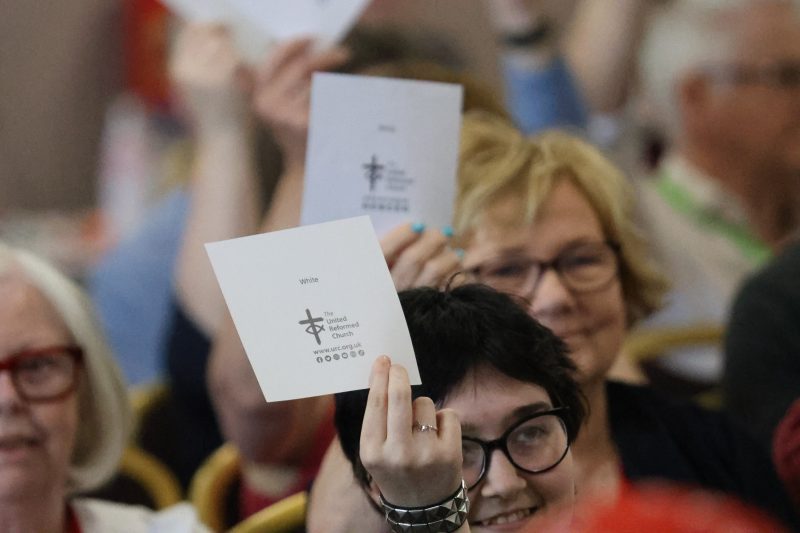
With regard to Resolution 14, Sarah said the proposal recognises that reparative justice is built through long-term relationships rather than one-off funding. She said the Task Group has already established trusted partnerships in Jamaica and the UK, and that the resolution would provide the flexibility needed to develop those relationships and respond to future opportunities. Resolution 14 was carried.
The wording of Resolution 15 was amended to say: “General Assembly delegates the authority to determine a specific funding allocation for each project to the Faith in Action and Business committees, to be advised by the Legacies of Slavery Task Group, bringing dates to General Assemblies via the usual reporting processes”. This too was carried; as was Resolution 16, which requires the Task Group to work with senior leadership, legal advisors and other relevant bodies to ensure appropriate governance, safeguarding and financial oversight. The Task Group then received a round of applause.
K1 – Gendered language in the Basis of Union
The Basis of Union and its schedules are foundational documents for the United Reformed Church, setting out the Church’s understanding of its own identity, mission and purpose.
In Resolution 46, URC Youth Assembly asked that the gendered language in the Basis of Union and its schedules, reflective of the times at which the document was written, be reviewed, with the aim of exploring potentially more inclusive language. It has been noted that some of the language used in the Basis of Union documents is heavily gendered.
The Youth Moderator, Kacie Hodgson, said the language as it stands doesn’t reflect the URC’s commitment to the ministry and roles of women in the denomination; nor does it acknowledge the existence of ministers who identify as non-binary and gender nonconforming, who are already working in the URC. At the same time, Kacie stressed the importance of respecting the broad range of theologies held across the denomination, and said that no changes to doctrine or structure were being suggested.
She said URC Youth Assembly feels that it is important to recognise that there is room for improvement; and that if in fact no such appropriate language exists at the moment, “then at least we have taken the first steps and begun a discussion”.
One youth member of the Assembly asked whether a timescale could be attached to the resolution. The General Secretary said that requiring a report to come to Assembly 2028 would be achievable.
One Assembly member commended Youth Assembly for bringing the resolution. She said language matters, but that it’s also evolving and expansive. In response, Kacie agreed, saying the Basis of Union is a living document – “it’s never meant to be set in stone”.
The resolution was carried by a majority.
K2 – Place of URC Youth
The General Assembly instructed the Business Committee to establish a task group to explore the identity, purpose and future development of URC Youth. It instructed the task group to report to Youth Assembly in 2027 and to bring final recommendations to Youth Assembly 2028, which, if adopted, would form the basis of recommendations to be brought to General Assembly in two years’ time.
Following the Church’s structural review and recent governance changes, URC Youth Moderator Kacie Hodgson said that the Church must reconsider the identity, purpose and role of URC Youth in light of changing patterns of church life and the experiences of young people today.
The paper identified several key challenges:
- inconsistency across the denomination in the opportunities and support available to young people;
- national youth structures feeling distant and inaccessible to local churches;
- too much focus on events rather than sustained relationships, discipleship and ongoing engagement;
- young people’s increasing geographical mobility making traditional models of church membership more difficult;
- young people wanting their voices to be integrated into the wider decision-making of the General Assembly, rather than separate structures.
The work will be closely coordinated with the Children and Youth Development Officers.
The proposed 12-person task group would consist of young people with lived experience, alongside representatives with governance and institutional knowledge. Members would be appointed through the Nominations Committee.
The proposed timetable includes scoping and planning by the end of the year, research and consultation across the denomination, particularly with young people, in 2027, and presentation of recommendations to General Assembly for approval and implementation in 2028.
Kacie concluded by saying that the proposals were not about managing decline or making minor organisational adjustments, but about discerning God’s calling for youth ministry in the URC and creating a clear, sustainable vision for the future.
Billy Logan, East Midlands Synod, explained he was not a member of the URC by choice because the current membership model doesn’t work for him and for others. He commended the paper. Reuben Watt, West Midlands, is a member of a local URC but feels more at home at Youth Assembly and Greenbelt. The transition from URC Youth to the wider URC should be looked at to stop people losing their connection to the URC.
Nicola Furley-Smith asked if Ministries could be part of the task group (which Kacie explained was an omission in the writing of the paper).
Tom Osborne, Methodist representative, shared the impact of 3Generate, which meets at the National Exhibition Centre for a weekend in October with 1,800 young people and helpers. He encouraged discussions with ecumenical partners.
It was also noted that while more than 25,000 under-26s are associated with the life of the URC, only a small proportion engage with Youth Assembly, suggesting there is significant untapped potential.
Resolutions 47, 48 and 49 were carried.
K3 – Involvement with the Welcome Directory
Presented by Maya Withal, a member of URC Youth and based within the National Synod of Scotland, Paper K3 encourages local churches to engage with the Welcome Directory, a charity active in every prison across England and Wales, which lists faith and belief communities willing and able to welcome and support people leaving prison.
Maya, a former URC Youth Moderator, supported by Jay Tynan of North Western Synod, explained that the heart of the paper is to raise awareness of Welcome Churches’ work. Maya explained that the paper did not seek to mandate that churches get involved with the charity, but encourages those who feel equipped, resourced and called to do so.
Maya further explained that joining the directory would not bypass the URC’s safeguarding policies and procedures but work with them, and also that the charity provided free training on welcoming prison leavers.
Following a short debate around safeguarding in practice in local churches, on who determines the risk of prison leavers (the prison or probation service), who makes the decision on whether to join the directory (Elders/local church meeting), a change to the amendment to read:
- General Assembly encourages local churches to work with the Welcome Directory, to help prison leavers with joining faith communities, in line with guidance in the URC’s safeguarding Good Practice document, and after agreement from the Synod Safeguarding Officer and Synod Pastoral Committee or equivalent.
Maya further explained that the charity provides a range of support and free resources. Resolution 50 and 51 then carried.
P2 – Keeping Trans people safe (Wessex Synod)
General Assembly passed resolutions inviting those local churches who want to do so to offer clear voluntary affirmation of the dignity of transgender people and signposting of their commitment to their pastoral care.
The 2023 Assembly agreed a statement along these lines and churches who support it are invited to publicly affirm it. St Columba’s URC, Oxford, has started to do this on their church website. Churches making similar affirmations can indicate their support as part of the Annual Return for publication on the URC’s online “Find a church” tool.
Wessex Synod said it did not seek to reopen the debate behind the 2023 General Assembly statement on transgender, or to persuade any local church to adopt a particular view. Rather it invites those churches which wish to do so to make clear their support for the 2023 statement.
Chrissie Chevasutt, Outreach and Development Worker with the Transgender, Intersex and Non-binary Community at St Columba’s, seconded the resolution, saying that transparency is vital to the safety of trans people, who need to know where they will be welcome.
A number of members of Assembly spoke warmly in favour of the proposal. Jo Clare-Young, Convenor of the Equality, Diversity, Inclusion and Belonging Sub-Committee, said that though she supported the aims, she questioned the mechanism, in which churches self-identify on their websites and on “Find a church”. Church websites are often out of date, she said, and are churches as welcoming as they think they are?
The resolutions were passed.
Paper Q1 – Response to the impact of single-sex court rulings on transgender people and their communities
The General Assembly recognised the challenges and decisions faced by organisations as they have responded to recent rulings and definitions regarding the protected characteristic of sex.
It also expressed deep pastoral concern for those affected by the decisions regarding trans people made by Girlguiding and similar organisations in response to the Supreme Court ruling regarding the characteristic of sex.
Kacie Hodgson, URC Youth Moderator, introduced a private members resolution, endorsed by the URC Youth Executive, and said that the URC has a longstanding tradition of speaking out on social justice and supporting vulnerable and marginalised people, and that this resolution continues that tradition.
In April 2025, the UK Supreme Court ruled that, for the purposes of the Equality Act 2010, “sex” refers to biological sex.
This has resulted in organisations such as the National Federation of Women’s Institute and Girlguiding amending their membership policies to align with the court decision.
These organisations should not be blamed, Kacie emphasised, as they were responding to legislative complexities rather than acting out of prejudice. But the pastoral consequences means that transgender young people may lose access to groups where they previously felt accepted; friends, families and wider communities are also affected when children are excluded from established social networks; and the resulting feelings of grief, rejection and isolation could extend beyond the individuals directly affected.
The Assembly was reminded about its 2023 commitment affirming the dignity of transgender, non-binary and gender non-conforming people, and said that those earlier commitments should now be put into practice.
The resolutions do not seek to challenge the law or criticise organisations that have changed their policies, Kacie continued. Instead, it calls on the URC to stand in solidarity with transgender people affected by these changes; encourage churches that feel able to do so to provide welcoming and affirming spaces for LGBTQ+ people; continue to support those offering pastoral care to transgender young people and their families; to ensure that, where other organisations have had to close their doors because of legal constraints, churches remain places of welcome and compassion.
They also called for the Church to review its policies and guidance in light of changes, provide practical advice to congregations, and work ecumenically and with partners to advocate for the wellbeing, safety and human rights of transgender people while ensuring compliance with the law as it evolves.
Charlotte Samson said that trans suicide rates are skyrocketing and challenged the URC about what it could and should be doing, to make all feel supported and safe like Jesus taught us to do. Claire Nutt shared concerns about the churches with connections to Girlguiding.
Following the Supreme court decision, the Equality and Human Rights Commission (EHRC) has prepared updated draft guidance which is currently before parliament for approval. This clarifies that organisations wishing to remain single-sex can lawfully do so based on biological sex regardless of gender identity or a Gender Recognition Certificate.
The resolution was passed.
[Note: After the time of writing, on 9 July the EHRC guidance referred to, namely “The Services, Public Functions, and Associations Code of Practice”, became statutory, following the normal 40-day scrutiny period.]