

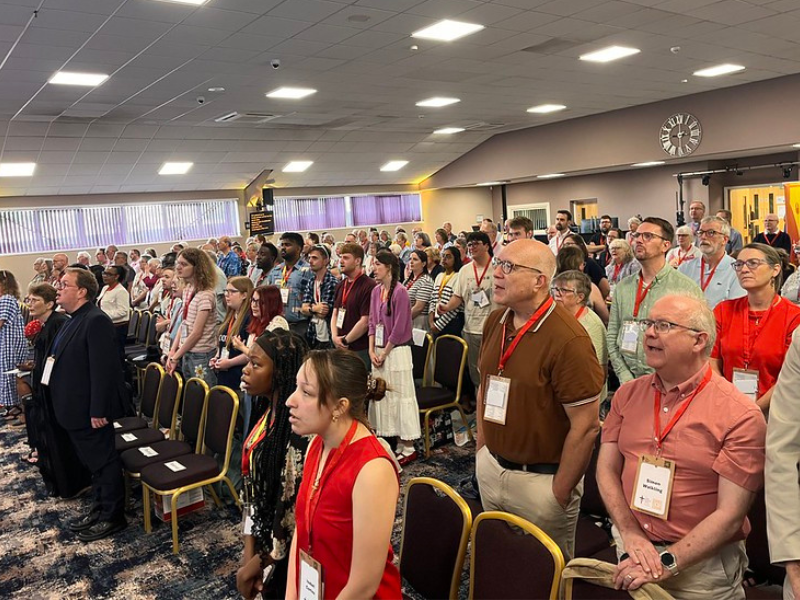
The 2026 meeting of the United Reformed Church General Assembly, opened at The Hayes Conference Centre in Swanwick on 3 July.
Mrs Irish Sirmons, Convenor of the General Assembly Business Committee, welcomed members of Assembly.
The Bible was brought forward by Ms Kacie Hodgson, Moderator of Youth Assembly, and she was followed by officials of Assembly. The Revd Dr John Bradbury, General Secretary, invited the Moderator, through her chaplain, and an act of worship, to constitute General Assembly 2026.
Opening worship
An opening service of worship was led by the Moderator’s Chaplain, the Revd Jane Wade; beginning with Bessie Porter Head ‘s hymn “O breath of life come sweeping through us”.
Having retold the story of the first Pentecost (Acts 2: 2-4), Jane said that, as Assembly, “we do not gather because we have all the answers, but because God’s Spirit is still at work, inspiring and guiding”. She introduced the theme of the weekend’s Bible studies: “God empowers ordinary people in ordinary places to do extraordinary things”. God does not call the equipped; God equips the called, she said – a theme underlined by a reading from St Paul’s first letter to the Corinthians, verses18 to 31.
Jane invited the Revd Dr Peter Green to introduce his Bible study series for Assembly.
Peter said his Bible studies would focus on individuals who in one way or another were marginal in their societies: Melchizedek; the unnamed Syrophoenician/Canaanite woman who asks Jesus to exorcise her daughter; and the apostle Barnabas.
He said two principles apply to the readings at the heart of the studies:
- The whole of Scripture is the story of the human race – “your story and mine is in scripture”, so we have to ask, “Where am I in this story? Who am I in this story?”
- The New Testament is hidden in the Old Testament; the Old Testament is revealed in the New Testament.
Inspired by words of C.S. Lewis, Peter added that Scripture passages that include details we nowadays find repellent more often than not hold important truths, especially if look for the ways in which Old and New Testaments are intertwined. He concluded that “our hope and prayer is that, with the gift of the Holy Spirit, really ordinary people will be empowered to do extraordinary things”, adding that “these could be extraordinarily bad things but we hope they will be extraordinarily good things”.
Jane Wade then led Assembly in the sharing of Holy Communion.
Ecumenical guests
Ms Lindsey Brown, Head of Ecumenical Relations and Evangelism, introduced ecumenical guests from the UK:
- Fr Marc Homsey, National Ecumenical Officer for the Catholic Church in England and Wales
- Right Revd Gordon Kennedy, Moderator of the Church of Scotland General Assembly
- Revd Tom Osborne, Methodist Church in Britain
- Revd David Warboys, Baptist Union
- Revd Dr Charles Baczyk-Bell, Church of England
Ms Karen Campbell, Head of Global and Intercultural Ministries, welcomed guests from international partner Churches:
- Janet McConnell, Council for World Mission Secretary for Social Justice
- Pfarrer Martin Henninger, Evangelische Kirche der Pfalz
- Dr Joanna Simpson from Jamaica (Assistant Lecturer, University of the West Indies)
- Revd Najla Kassab, National Evangelical Synod of Syria and Lebanon, and a former President of the World Communion of Reformed Churches (2017–25)
- Sadly unable to be at Assembly in person was the Right Revd Dr Collin Cowan, Moderator, United Church of Jamaica & the Cayman Islands
Fr Marc Homsey and the Revd Najla Kassab were invited to address General Assembly.
Fr Marc Homsey said it is an exciting time for the Catholic Church, with a new Pope who has already shown how important ecumenical relations are to him. He said that the fourth phase of the Roman Catholic/URC Dialogue Group will soon be convened by the URC’s General Secretary, the Revd Dr John Bradbury, and Bishop Paul Hendricks, Auxiliary Bishop for the Kent area of the Roman Catholic Diocese of Southwark. The discussions have the working title, “Being the People of God”.
The Revd Najla Kassab said that, recently, she had walked over a bombed bridge that crosses the border from Lebanon into Syria, in order to visit churches that are in her synod. “The bridge had been damaged, but it still did not stop me from reaching out and to live hope. It reminded me that nothing – not even war, destruction – can separate us from sharing the love of Christ with one another. God’s love always finds a way across broken places.”
She said that though Assembly was gathering in a world marked by uncertainty, conflict, and deep division, “yet we remain people of hope because our hope is rooted in the living Christ”, and she said: “May we all have the courage to cross bridges – not only the physical bridges damaged by war, but also the invisible bridges that divide our communities, our churches. May we dare to see the world from the other side of the bridge, to discover perspectives different from our own, and to stand where God stands – with those who long for justice, peace, and hope.”
Session one
Introductions and Greeting of Ecumenical Guests
En bloc
The following reports and resolutions were passed en bloc. En bloc items 1are voted on without debate, having been deemed uncontroversial. This has no reflection on their importance. Read the full reports and resolutions for each paper.
Synod Moderator’s Report
An invitation to churches to reflect on our hope in Jesus and on where we can bring God’s hope into the world today.
Senior Leadership Team Report
An update on the work of the team, and the agenda for work emerging from the General Assembly.
A1 – Business Committee Report
An update on the work of the committee and decisions taken on behalf of the General Assembly since Assembly Executive met in February 2026.
AD1 – Church Life Fund Progress Update
Approving the terms of reference of the CLF Committee and providing for the appointment of committee members.
B1 – Faith in Action Committee Report
An overview of the work of the committee and team since September 2025, including children, youth and intergenerational; communications; equalities, diversity and belonging; evangelism and ecumenism; global and intercultural ministries; global justice and interfaith; lay learning; public issues.
B4 – Future of URC at Greenbelt
Extending the URC’s presence at Greenbelt festival for three years, granting funding and requiring annual reports on effectiveness.
B5 – Net-Zero Task Group Report
An update on the activity of the Task Group, including the report on annual synods’ progress towards net zero.
B6 – Net-Zero Terms of Reference
Adopting terms of reference for the Net Zero Task Group.
C4 – Active Ministers Policy
Adopting the revised Active Ministers Policy, which provides a framework for the recognition, authorisation and accountability of active Ministers of the Word and Sacraments, and CRCWs.
C5 – Inactive Ministers Policy
Adopting the Inactive Ministers Policy, which distinguishes between lifelong ordination and current authorisation to minister.
C6 – Review of Ministers Retirement Age
Affirming the normal retirement age of 68 for Ministers of Word and Sacraments and CRCWs, and the existing procedure for extension.
C7 – Process for ill-health early retirement
Adopting the process for the ill-health early retirement of office-holders, aiming that ministers continue to be treated in accordance with the current arrangements.
C8 – Competencies and Expected Standards
Adopting the framework of Competencies and Expected Standards of Conduct and Behaviour for Ministers.
C9 – Reasonable Adjustments
Adopting the Reasonable Adjustments Policy, which aims to remove barriers arising from disability or health conditions for Ministers, CRCWs and those in training.
C10 – Sickness and Ill-health
Adopting the revised Sickness and Ill Health Policy for Ministers of the Word and Sacraments and Church Related Community Workers, following changes to the law.
C11 – Accreditations Sub-Committee Terms of Reference
Adopting the revised terms of reference for the Accreditations Sub-Committee of the Ministries Committee.
CD1 – Ministry & Mission Fund Review Task Group
An update on the work of the Resolution 46 Task Group, established to undertake a URC-wide consultation on the sustainability of the Ministry and Mission Fund. The process is being developed, and findings and options will be brought to General Assembly in 2027.
CH1 –Ministries Support and Wellbeing Sub-Committee
Creating a single Ministries Support and Wellbeing Committee, bringing together the work of the Pastoral Reference and Welfare Committee and the Maintenance of the Ministry Sub-Committee.
G1 – Nominations Committee Report
Establishing best practice for selecting synod reps for General Assembly, to be communicated through new resources. Two members of the Church Life Fund Committee will be coopted to ensure diversity. Appointments include the Revd Dr John Bradbury as General Secretary, and the Revd Jamie Kissack as Moderator of the Yorkshire Synod, both for second terms.
H1 – Pastoral References and Welfare Committee Report
Update on the work and future of the committee and its oversight of welfare funds.
I1 – Safeguarding Committee Report
Annual update of safeguarding in the URC, including highlights, risk areas, areas of development, and a summary of church safeguarding returns.
J1 – Worship, Faith and Order Committee Report
An update on the work of the committee.
J4 – Assisted Dying
Commending ‘A Theological Resource on Assisted Dying’ to churches as an aid to discussion.
J5 – Permission to Coopt Members
Allowing the Worship, Faith and Order Committee to co-opt specialists and URC members of ecumenical or international bodies.
P1 – New Synod Name
Changing the name of the Wessex Synod to the Wessex and Islands Synod, from 1 January 2027.
Nomination of individual appointments
The appointments were celebrated at General Assembly and greetings were offered to:
- The Revd Dr John Bradbury is appointed to serve as General Secretary for a further term of five years.
- The Revd Jamie Kissack is appointed to serve as Moderator of Yorkshire Synod for a further five-year term.
- The Revd Revd Nicola Furley-Smith is reappointed to serve a second term as Deputy General Secretary (Ministries); and
- Karen Campbell is reappointed to serve a second term as Head of Global and Intercultural Church
- Mike Thomason was also welcomed as Moderator of North Western Synod.
Keynote — Dr Krish Kandiah on “The Surprising Power of Hospitality – how to respond to the rise of Christian Nationalism with grace and truth”
Krish Kandiah is founder of The Sanctuary Foundation, a charity that supports refugees to find welcome, work and housing in the UK. He is also a passionate advocate for supporting children out of the care system through adoption, fostering and kinship care. He was invited by the Moderator, Catriona Wheeler, to address Assembly.
Krish said that his theme was radical hospitality and what he regards as its polar opposite – toxic nationalism.
He spoke about his own family, which has grown out of a mixed-race heritage. His mother was brought over to Britain from an orphanage in India and became a nurse, “to give something back” to the country that had given her a home, but experienced extreme racism and xenophobia. She responded by cooking up a meal every Friday and inviting others who didn’t “fit in” (including “a tall, young Malaysian student” who became Krish’s father).
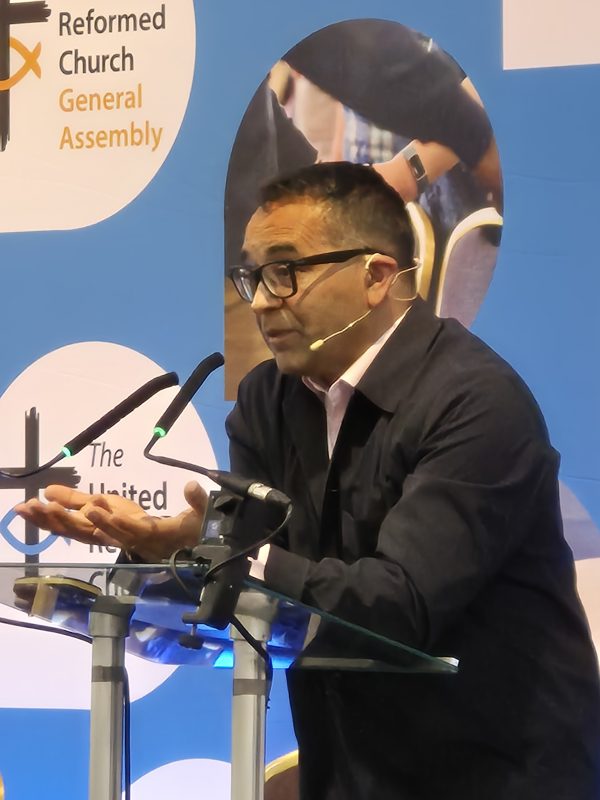
Krish, who has founded a fostering and adoption charity, used this topic as way of helping Assembly understand what radical hospitality can look like. He said that one of the ways we show what the grace of God is like is by caring for the most vulnerable in society. He said that, though we are all experiencing the same world (and Assembly members chose quite dark words to describe it – “concerning, worrying, challenging, confusing”), as Christians we should see the world differently. Sometimes we struggle to do this, Krish said.
He used the example of Robert, a child in care, who, at five-years-old has “difficult to manage behaviour”. Krish said that most prospective adopters who consider Robert’s profile move on because they are concerned about what that behaviour will look like when he’s 15. Krish’s question was: “When God looks at Robert, what does God see?” A range of possibilities were offered, with discussion focusing on questions of vulnerability and humanity. Krish then used these responses to speak about what he sees as a parallel issue: attitudes to those coming to the UK from other countries.
Krish compared the public response to providing a home for refugees from Ukraine with similar appeals to provide hospitality to refugees from Sudan and young medical evacuees from Gaza. “It probably took as much effort to get five Gazan children over [to the UK] with their mothers as it took to bring 250,000 Ukrainians. He cited his experience of Christians who were critical of what Hamas had done in Israel but had then applied the same anger towards the care of Gazan children in need.
Using a clip of an interview he had given to GB News, Krish emphasised the need to see as human those who disagree with you. He argued that Jesus, the Good Shepherd, had a voice for those who were weary and heavy laden, and another voice for “the wolves” – a voice that criticised religious leaders. He said that sometimes “we use the wrong voice on the wrong people. I think if Jesus was looking at the audience of GB News, he would offer them rest too.” He argued that we need to be welcoming to those white, working-class people who have been left behind as well as those who have fled to our country for asylum. It’s both/and, not either/or, he said. As people of God, in our local church we are part of the local but care about the global. “You can’t choose between your heart or your lungs – one is not more important than the other. When we are speaking out for the vulnerable, speak for local and global at the same time so that you can’t be accused of being for one and not for the other.”
Finally, Krish spoke of Christian leaders taking distinct political positions: some “jumping into the culture war with both feet, mainly from the right-wing end of the political spectrum” and using the Christian faith as a barrier to keep other people out; others drawn to “the other end of the political spectrum – equity, welcome, fighting injustice –“ but arguably pursuing a “progressive project that goes beyond what the Bible says”. Others avoid both extremes but end up “neutering” the Bible and abdicating from the Church’s prophetic task. Our work, Krish concluded, is to be discerning – to show the world that God calls us to radical hospitality.
Paper B3 – Faith in Action – Inter Faith
The Faith in Action Committee presented a report on the URC’s interfaith work, with three resolutions, in different areas, which were all passed.
Resolution 7 is to work towards a joint Christian-Muslim declaration. The past year has been a wake-up call for the Church’s commitment to interfaith work, the committee says. The rise of far-right nationalism invoking the name of Jesus to vilify other religions is sending shockwaves through the Church.
However, there is no established structure for Muslim-Christian engagement at senior denominational level. The resolution is intended as a step towards such an organisation. The committee will report back on progress to the 2027 Assembly.
Sarah Lane Cawte, Convenor of Faith in Action Committee, said the resolution was about overcoming division and intolerance, and developing more cohesive and resilient communities.
She commended the publication ‘Reaching Out In Love’, an interfaith toolkit developed by the Revd Peter Colwell, and published by Churches Together in Britain and Ireland. Learn more about the URC and its interfaith work.
Resolution 8 commends prayerful study of ‘Kairos II’, a document produced by Palestinian Christians reflecting their experience and perspective. Ms Lane Cawte said that ‘Kairos II’ was offered for reflection, not in the expectation that readers would necessarily agree with all of it. She said the committee had consulted with the Council for Christians and Jews, who would be responding to ‘Kairos II’ in due course.
Resolution 9 creates a task group to address antisemitism in the Church. Ms Lane Cawte said members of Assembly might be shocked by the idea of antisemitism in the URC, but she compared it to the URC having learned that it needed to tackle racism and start to become an anti-racist church. The Woolf institute has identified areas for review.
A point emerged in debate which Ms Lane Cawte heartily agreed with: commending involvement in local authority Standing Advisory Council on Religious Education (SACRE) meetings.
Paper B2 – Five Marks of the Faith in Action Team
General Assembly commended the Five Marks for the Faith in Action (FiA) team, which was created last September following a restructure with the staff of the Office of General Assembly.
The framework for the team was to support its work and help to set priorities. It used a framework based on the Five Marks of Mission and adapted it for the work of the team, helping it to ensure coverage of all areas related to discipleship and mission.
Jenny Mills, Deputy General Secretary (Faith in Action), said: “We knew that a clear framework for our work would help us become better at not only asking ‘what shall we do’, but also what should we stop doing. This idea blossomed and is already providing the what, the how and the why whilst we’re focusing on mission and discipleship in their widest forms … I offer this paper to the General Assembly as an act of encouragement for the whole FiA team.”
The team is responding to a wide range of General Assembly work so there is need for a broad, descriptive framework to clarify it.
The paper included next steps, future suggestions and the FiA Team Creed.
Paper P6 – Mersey Synod – Evangelism
Presenting Paper 6 on behalf of Mersey Synod, its Moderator, the Revd Geoff Felton, said that the paper wasn’t so much about bringing resolutions as about inviting local congregations to express, confidently, the hope that we find in Christ and the Gospel life we express through worship. The paper had arisen out of the Synod’s Talking Faith project, designed to help churches build confidence among church members to enter into conversation about questions of faith.
Emphasising the centrality of worship, the report described evangelism as “a matter of discipleship not desperation” and as best understood as “invitation to encounter”. It argued that hesitancy to speak confidently about the Church as Christ’s presence in the here and now “can unintentionally weaken evangelistic confidence”.
One member of Assembly asked, with reference to a comment in the paper, which forms of mission and theologies are “insufficient”. Mr Felton said there was concern about when the work of God is not considered to be active in the world today but did say no particular theology was being criticsed. Another speaker asked about materials that might be recommended to help churches make evangelism integral to their work. Mersey Synod has produced some resources that are available to others but Mr Felton said it would be helpful if other URC resources were produced nationally.
In response to another question, Mr Felton said that evangelism in Mersey Synod became increasingly “relational” as a result of the Talking Faith initiative – it wasn’t about enforcing certain ideologies.
Resolution 61, containing Mersey Synod’s invitation to affirm evangelism as integral to the life and mission of the United Reformed Church, was passed.
Session two
Paper B7 – Legacies of Slavery: Affirming the will and finding the way(s)
Introducing the discussion, Lindsey Brown, Head of Evangelism & Ecumenism, explained that the paper on the Legacies of Slavery being presented to General Assembly was, in one sense, a formality. Much of its content had already been considered by previous General Assemblies, which had authorised the work undertaken so far. However, she stressed that some formal decisions and processes still needed to be completed. The purpose of both the paper and the discussion session was therefore to enable the Assembly to formally ratify work that was already underway, while also providing an opportunity for questions, concerns and further reflection. Lindsey noted that although the journey began several years ago, not everyone in the Church has been part of those conversations. She encouraged members to engage with the issues, share differing viewpoints where necessary, and help shape the work going forward so that as many people as possible can participate in the Church’s ongoing journey of learning and action.
Lindsey then asked each of the panel members — David Reynolds, Joanna Simpson and Karen Campbell — to introduce themselves and explain why they had engaged with the issues around Legacies of Slavery.
David Reynolds, Convenor of the URC’s Legacies of Slavery group
David explained that he became involved after being asked to take on the role by John Bradbury. As a historian who teaches and writes about the past, he was concerned that Britain is often not fully honest about its history, an issue that he believes is closely connected to his Christian faith. Reynolds described his involvement in the project as both a responsibility and one of the most moving experiences of his Christian life. Working alongside people from a range of backgrounds and perspectives has deepened his understanding and reinforced the importance of the Church engaging honestly with the legacies of slavery and their continuing impact today.
Dr Joanna Simpson, Lecturer in Community Social Work – University of West Indies
Joanna reflected on how her work in community social work and her upbringing in Jamaica shaped her understanding of justice and social transformation. As the daughter of a pastor committed to social justice, she was exposed from a young age to communities facing significant challenges and saw the impact faith could have on people rebuilding their lives. Her later research into crime and violence in Jamaica led her to examine the deeper social and historical causes of these issues. She concluded that many present-day inequalities and patterns of violence are rooted in the enduring legacy of colonialism and its impact on communities. Joanna emphasised that tackling these challenges requires addressing the social factors that undermine dignity and opportunity. She also highlighted the vital role of churches and faith volunteers in promoting justice, mercy and transformation, particularly through supporting young people and responding to issues such as youth violence.
Karen Campbell, Head of Global & Intercultural Church
Karen reflected on her journey with the URC’s Legacies of Slavery programme, which began in 2017 through the Council for World Mission’s work exploring the history and continuing impact of transatlantic slavery. She explained that, despite growing up in the UK as the daughter of Jamaican parents and being aware of racism and inequality, she had not fully understood how deeply these experiences were connected to the legacy of slavery. Through her involvement in the project and later the URC task group, she embarked on a significant journey of learning and reflection. Since taking a leading role in the work in 2020, she has sought to encourage others to engage with the same process of learning. Karen emphasised that people begin from different backgrounds and levels of understanding, but the important thing is a willingness to grow in awareness, become allies, and help bring about positive change.
Lindsey Brown, Head of Evangelism & Ecumenism
Speaking about the URC’s work on the legacies of slavery, Lindsey recalled that many local churches initially felt disconnected from the issue, seeing it as something from the distant past with little relevance to them. As an elder, Lindsey experienced this reaction firsthand during the consultation process. Joining one of the Legacies of Slavery subgroups gave her the opportunity to represent those perspectives, but it also became a significant learning journey. Lindsey reflected on how much she had not previously understood about the subject and described the process as both eye-opening and challenging. Lindsey said she believes the URC’s extensive consultation, which engaged the whole Church from the outset, has enabled it to make greater progress on the issue than some other denominations.
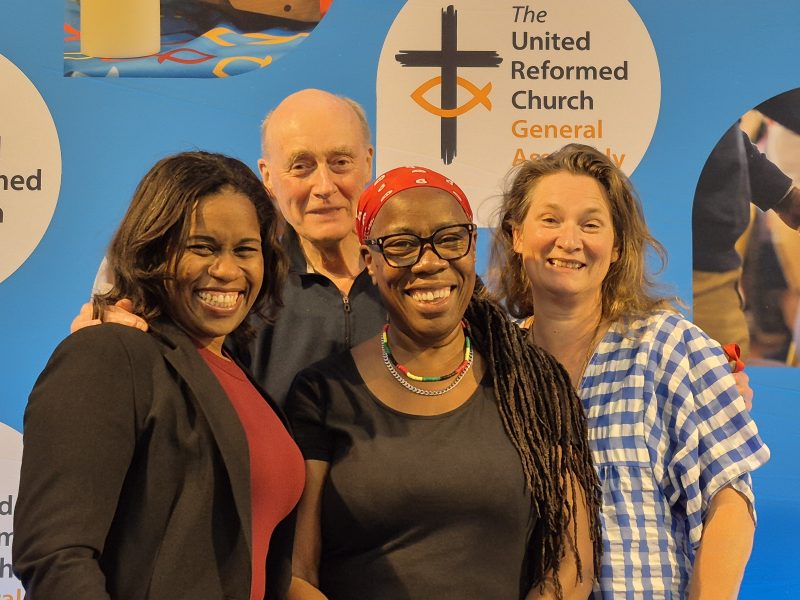
Video presentation by the Revd Dr Collin Cowan
The Revd Dr Collin Cowan, Moderator of the United Church in Jamaica and the Cayman Islands (UCJCI), praised the URC for its “courage and commitment” in acknowledging its historical involvement in transatlantic slavery and committing to reparative justice.
Speaking from the UCJCI’s first Garden of Justice, Reconciliation and Peace, Dr Cowan described the URC as the first church within the Council for World Mission to respond to the call to address the legacies of slavery through apology and practical action.
He said reparations are not about charity or token gestures, but about repairing broken relationships and working together to create a more just future.
“When we talk about reparations, first and foremost we’re talking about building bridges of reconciliation,” he said. “Only after we have repaired broken relationships can we talk about financial relinquishment.”
Reflecting on the devastation caused by Hurricane Melissa, Dr Cowan said the storm had exposed the continuing legacies of slavery, with the poorest communities suffering the greatest losses. Many people remain without secure housing months after the hurricane, leaving them vulnerable as another hurricane season approaches.
He urged the URC to continue its partnership with the UCJCI by supporting the creation of three new villages to provide safe housing for communities most affected by both the hurricane and the long-term effects of historic injustice.
“If the United Reformed Church were to work with the United Church in Jamaica and the Cayman Islands, we could build at least one of these three villages,” he said.
Calling on churches to confront their shared history, Dr Cowan concluded: “We must do whatever it takes to change that narrative and create hospitable communities in which all of us will flourish together, live in peace and harmony, serve one another and give honour and glory to the God of justice.”
Lindsey then explained the three-strand ‘repairing justice’ proposals of the paper: global, regional, and local aspects.
David and Karen highlighted key points of the Global strand. David explained that the legacy of slavery remains visible in Jamaica today. He highlighted that around 30% of the population has no legal right to the land on which they live, leaving many families living in insecure housing.
He said Hurricane Melissa had exposed that vulnerability, with many of those already living in precarious circumstances suffering the greatest losses.
Referring to Issue 3 of Reformed magazine, David explained that the Churches Reparations Action Forum (CRAF) is working to use church-owned land to develop sustainable, hurricane-resilient housing as a practical response to the continuing legacy of slavery.
Joanna — who visited the URC’s central office in November as part of a collaborative project between the URC and the Ascension Trust about a mentoring project for young black man in key demographic areas of the URC — shared powerfully about the Regional strand.
Joanna started by reflecting on a biblical basis for reparative justice and said that the Church is called not only to pray and worship, but also to take practical action against injustice.
Drawing on Isaiah 58–61, she argued that God calls Christians to “loose the chains of injustice”, care for those who are oppressed, comfort the broken-hearted and work for justice and mercy. Jonna went on to say that the legacy of slavery, including its ongoing trauma, is part of that calling, and added that the Church’s mission is to combine evangelism with practical expressions of love and justice. “God requires it,” she said. “Faith must be lived out in acts of justice, mercy and love for our neighbour”.
Karen outlined the third strand of the Legacies of Slavery programme, which focuses on anti-racism within the URC itself. She said the Church’s anti-racism training is designed to encourage reflection rather than provide simple right-and-wrong answers, inviting people to examine privilege, challenge assumptions and recognise systemic racism. While the training has been well received, Karen said lasting change will require more than individual learning. The challenge, she said, is transforming the culture and structures of the Church so they no longer unintentionally perpetuate inequality. “We have yet to make that individual journey come together to change the organisation,” she said.
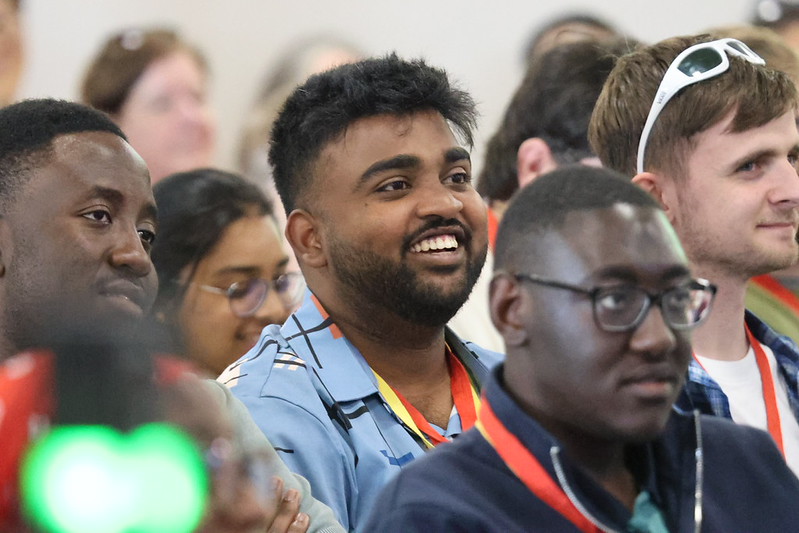
Each panel member then spoke about what has brought them joy about the work so far. A key moment mentioned was the URC’s confession and apology for its role in the Transatlantic Slave Trade.
Assembly then broke up into groups, to discuss the follow questions:
- How do you understand the term “reparations” or “repairing justice”
- What does it mean for the URC to be a community of justice in the face of injustice (how might this relate to our response to the Legacies of Slavery?
- What clarification do you need regarding these specific proposals
The paper will be discussed again on day two of Assembly.
Reporting team: Andy Jackson, Ann-Marie Nye, Laurence Wareing, Steve Tomkins. Pictures: Kevin Snyman.