

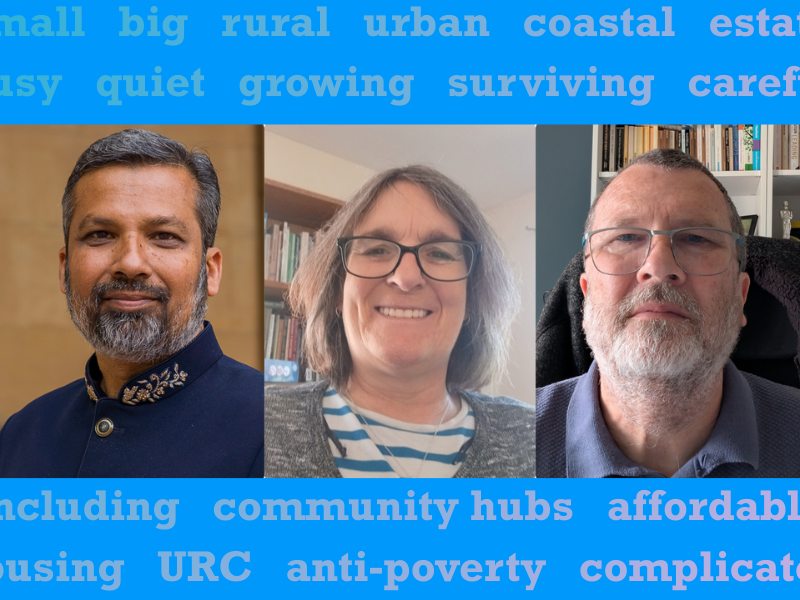
Churches were encouraged to listen deeply, build relationships and avoid making assumptions about local need during the second webinar in the United Reformed Church (URC’s) “A Church with People at the Margins” webinar series.
Themed “Knowing Your Community”, the session, hosted by Roo Stewart, Head of Public Issues, explored how congregations can better understand their neighbourhoods and work with local communities in ways that are practical, respectful and rooted in faith.
Opening the session, Vicky Longbone, Church Related Community Worker for Derby Alive2Community (A2C), a community project attached to Ashbourne Road Church and Mackworth URC in Derby, reflected on Jesus’ commandment to love God and love our neighbour.
“To truly love your neighbour is to want peace and justice for them,” she said. “Community work is not about what we think people need. It is about knowing what the real needs are.”
Vicky encouraged churches to carry out community audits before launching new projects. These, she said, help congregations understand local demographics, identify need, discover existing services, build relationships and avoid duplicating work.
Using the example of a church setting up a clothes bank without realising similar provision already existed nearby, Vicky warned that good intentions are not enough.
“Walk and talk, look and listen,” she said. “All four of those actions need to be intentional.”
Mike Hart, Transformation Director for North Western Synod, introduced practical tools including the Church Urban Fund’s Look Up Tool and the Gather Movement’s mapping of faith-based social action. Both can help churches understand local deprivation, poverty, isolation and existing community provision.
David Hey, Church Secretary at Albion Church in Ashton-under-Lyne, shared how a community audit helped his congregation better understand its town and focus its mission. The process led to a weekly warm hub, stronger community links and the appointment of a community church project worker.
“It gave us credibility,” David said. “When applying for funding, it showed we were serious and that we had evidence of what was needed.”
David also reflected on the encouragement of discovering how many people in the town still felt connected to the church through weddings, baptisms and family history.
David Jonathan, known as Johny, then shared the story of Grassroots Luton, where long-term presence, interfaith partnership and community mediation have helped build trust in a diverse town often unfairly associated with extremism.
Johny said: “Empowerment is not about gaining power and distributing it to others,” he said. “It is about being alongside people, accompanying people.”
The webinar’s key message was clear: churches do not need to solve everything alone. By listening carefully, working in partnership and responding rather than reacting, congregations can join in God’s mission already at work in their communities.
Play the video above to recap on Webinar 2: Knowing your community.
Webinar 3 themed “Places to meet” takes place on 10 August at 7pm. It aims to explore the following questions, plus more: can the church be the hub of the community? How can our spaces become a vibrant, life-giving and life-changing environment for the whole neighbourhood? What support and funding are there to help? How can we grow our volunteer base?
Register for webinar 3: 10 August – Places to meet
Webinar 4 themed “Community organising” takes place on 16 November at 7pm. In an increasingly individualistic and hostile society swayed by the loudest and the most privileged, how do we buck the trend and recapture the joy of collaboration and community? How can a community speak and act together to make a positive difference? And what has the church to offer into the mix?
Register for webinar 4: 16 November – Community organising
To catch up on past webinars see urc.org.uk/margins.