

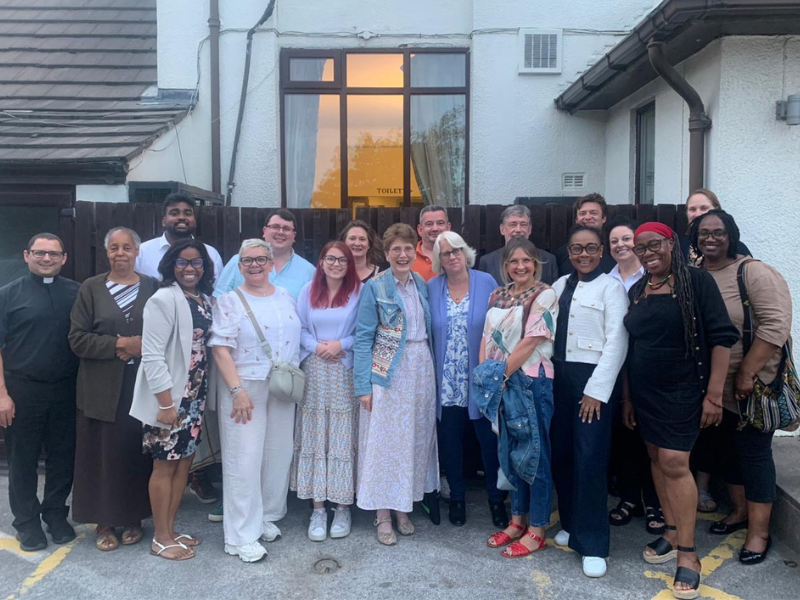
The 2026 meeting of the United Reformed Church General Assembly was concluded at The Hayes Conference Centre in Swanwick.
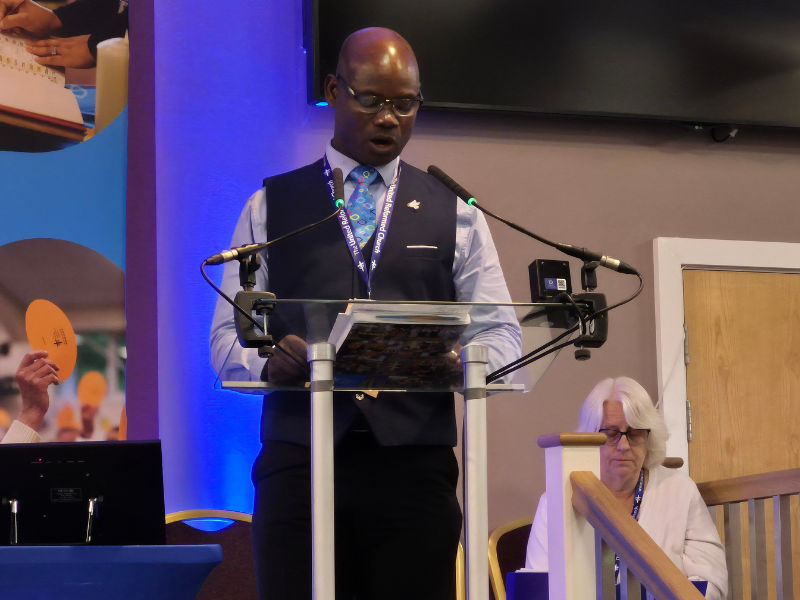
The day began with worship and the morning’s Bible Study.
Bible Study
The Moderator’s Chaplain, the Revd Jane Wade, led General Assembly in a Bible Study on Barnabas, whose name was a nickname meaning ‘Son of Encouragement’. Jane looked at how he developed the potential of Paul, noting that some of the people who have had most impact on our Christian lives are not the most talented or most recognised, but those who saw our potential and encouraged it.
Barnabas’s encouragement, said Jane, was not about optimism or positive thinking, but flowed from the Holy Spirit. His leadership was not about seeking followers but making leaders.
Barnabas also saw potential in Mark. When Paul and Barnabas disagreed about forgiving his lapse, Barnabas recognised Mark’s potential to overcome failure
Where Paul is remembered for what he accomplished personally, Barnabas is remembered more for the potential he nurtured in others. We are not all called to be Paul, some of us are called to be Barnabas.
Jane closed by asking, ‘What nickname would people give you? What would you hope it might be?’
Paper J2 – Worship, Faith and Order – Celebration of Creationtide
Presenting Paper J2, the Revd Dr Robert Pope, Convenor of the Faith and Order Committee, encouraged the URC to officially observe the Feast of Creation in Christ, also known as Creationtide or the Season of Creation. He said celebrating God as Creator is central to the Christian faith and noted that churches across the global ecumenical movement have been encouraged to include the feast in their liturgical calendars. While recognising that the URC does not have a formal liturgical calendar, he said observing the feast would both celebrate God’s creation and help churches respond to the ecological crisis facing the world. The paper also proposed curating worship resources to help congregations mark the season.
During discussion, the Revd Dr Susan Durber (Mersey Synod) described the proposal as “a huge moment in the story of Christianity”, saying it reflected a growing recognition across the worldwide Church of the theological importance of creation care. She urged churches to celebrate the Feast of Creation as enthusiastically as Christmas and Easter.
Responding to questions about the need for new resources, Dr Pope said many URCs already mark Creationtide, but the proposal was about joining ecumenical partners around the world in formally celebrating the Feast of Creation. He said it was an opportunity for the denomination to affirm both God as Creator and its shared commitment to caring for creation. The Revd Andy Braunston, Secretary for Worship, Faith and Order Committee, explained that the Revised Common Lectionary was suggesting different readings and thereby a different focus for the first Sunday in September. Officially recognising the day, will keep a focus on Creationtide.
Resolutions 41 and 42 were carried.
Paper J3 – Worship, Faith and Order – “Nature, Faith and order” – third version
The Revd Dr Robert Pope invited Assembly to adopt (Resolution 43) a shorter, responsorial version of A Statement Concerning the Nature, Faith and Order, which he said was close to the original text.
He said this is the one set of words required to be used in services of ordination, induction and commission. He said it is a living document that helps us proclaim who we are – an expression of our identity.
Version 1 was the original version of the Statement; Version 2, a responsive version.
Alvin Mark, a Youth delegate from Northern Synod, questioned the rewording in the proposed Version 3, which removed the explicit reference to the death and resurrection of Christ. The General Secretary said that this Statement is essentially a statement of order and is distinct from other, more comprehensive statements of faith.
The Revd Dr Michael Hopkins stood to oppose the resolution, primarily because “it dilutes our common life” – he referred to Version 3 as a “pick and mix” version of the original (non-responsive) version. He asked, if the Resolution is passed, that it be referred to local church meetings as well as to synods for discussion.
The Revd Lythan Nevard, Moderator of Eastern Synod, felt that Version 2 helps us respond to the statement whereas Version 3 “makes us part of the statement”. She asked if the main aim had been to make our services shorter. She said we should make the most of the fuller versions that describe who we are and what we believe in language of “beauty and poetry”.
Jamie Laird, a Youth delegate, said that, should this resolution not be passed it would be reviewed in any case as part of the already agreed task of reviewing the gendered language of the Statement and its schedules.
Alvin Mark remained concerned about the loss of a specific reference to the crucifixion and resurrection of Christ which, he said, is one key statement that is agreed upon across all Christian traditions. Other speakers criticised the layout and flow of Version 3, one describing it as “clunky”.
The Revd John Bremner, National Synod of Scotland, said the use of the statement should be used for more than just at ordinations, inductions and commissions. He said it was valuable as a resource for elders’ training, group discussion, as an introduction to who we are, and ecumenically.
Dr Pope recognised the discomfort of many in Assembly and proposed the withdrawal of Resolution 43. This was agreed, but this allows for the review, mentioned by Jamie Laird, of the gendered language in the document.
General Assembly Moderator’s Address 2026
“The past year has been a year full of blessings,” said Catriona Wheeler, General Assembly Moderator 2025-2026, as she delivered her address.
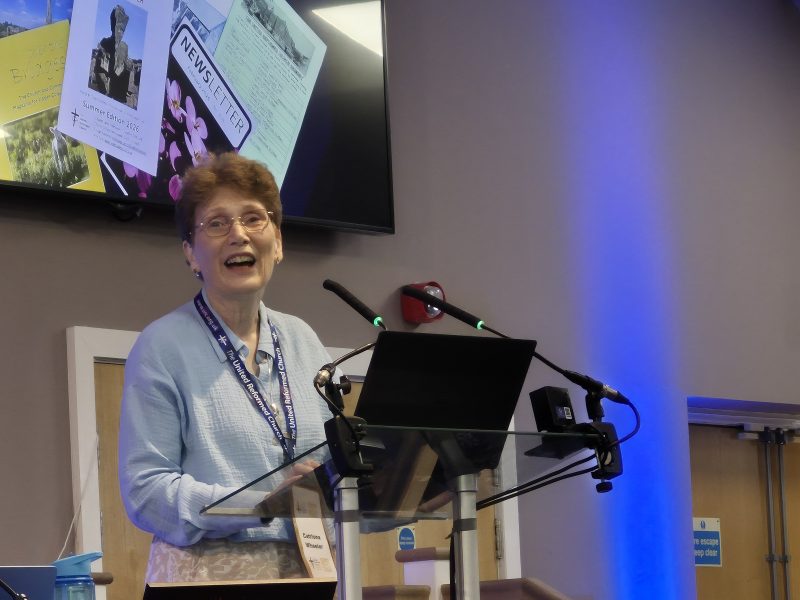
Passing on a piece of advice given to her from a past Moderator, Val Morrison, Catriona encouraged incoming Moderator Neil Thorogood to “savour the year”. Catriona went on to say that the “friendliness of each welcome” had been the highlight of her year.
“No matter where I have been or what I was visiting I was greeted with wide smiles,” said Catriona. “Often also cake or other food at some point during my visits. I’m surprised I’ve not increased a dress size.”
Explaining how her term started off quietly, after writing to synods asking for invitations to visit churches and their activities, invitations soon flooded in. Over the course of the year Catriona has visited churches in all of the URC’s Synods, even attending her first Messy Church service in Blackburn in June. “It was a fun time with a good mixture of worship and friendship,” she said.
Catriona also found that churches found it important to celebrate their anniversaries, no matter whether marking the event annually or in a year with a significant zero at the end of it.
“What they have in common is celebrating the Lord’s work in that community through the people of the church.”
The Moderator added that it had been “wonderful” to see the ways in which local congregations often worked with other churches and other members of their communities who feel called to serve God. The dementia café run in Diss URC, Northallerton’s secret garden, cafés in places such as Bocking and Wilmslow, and Wooler URC’s new labyrinth were highlighted as key places of inspiration along her travels.
People also voiced their concerns.
“None of these will be new to anyone here,” explained Catriona. “The main worries that people raised were members growing older without as many of a younger generation following behind; how they are becoming part of larger groups sharing a minister and what this will mean in practice; and responsibilities for church buildings.
“For myself these discussions have been especially poignant. My own church, Trinity URC in Lincoln, after much prayerful consideration decided to close and held its final service in January this year. A good number of us have been welcomed into St Columba’s LEP in Lincoln, where I am learning new ways of being church, while others have chosen to go to churches in their home villages surrounding Lincoln.”
Catriona said that she recognised all too well the many factors churches are considering when looking at their future.
“I pray that the Church Life Fund will provide a meaningful practical support to churches who will then be able to devote their energy to other aspects of church life.”
Referring to the dynamism of URC Youth, Catriona said she had been struck over the years by the high level of engagement that the Youth representatives have in the business of Assembly. Praising them, Catriona said they were always so well prepared and confident; qualities which showed themselves at Youth Assembly — a weekend blend of fun, prayerful discussions and joyful worship.
The Moderator went on to highlight opportunities to represent the denomination at ecumenical, civic and international events, including the Church of Scotland General Assembly, the installation of the Archbishop of Canterbury, and worship with partner churches in Germany, describing them as valuable occasions to strengthen relationships and share the URC’s witness. She also praised the work of the Joint Public Issues Team (JPIT), whose advocacy enabled the URC to speak out on issues including child poverty, refugees, peace in the Middle East, and human rights. Concluding her reflections, Catriona said that while the URC may sometimes be anxious about its future, it remains “a Church full of people who are devoted to doing their utmost to serve God” by serving others.
The Moderator concluded her address with a blessing she has used at the end of a number of services:
Go out from here with a pocket full of free gifts to give to those you meet.
Give freely your love and concern as a token of the greater love of God.
Give feely your time and effort as a token of the sacrifice of Jesus.
Give freely your help and friendship as a token of the upholding of the Spirit.
And may all you give and you do cause others to seek the true gift of the god who blesses without end.
Amen.
Moderator Elect 2026-2027 Acceptance Speech
The Moderator-Elect of the United Reformed Church General Assembly, who will serve as Moderator from 2027-2028, is the Revd Dr Susan Durber.
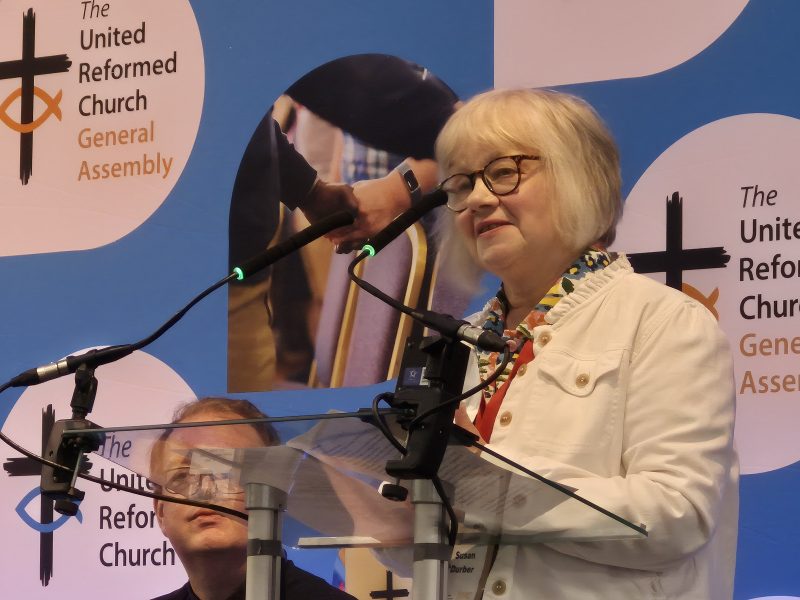
In accepting the role after the election held at the 2026 meeting of the General Assembly, Dr Durber said that she accepted it with gratitude, and in all humility.
Susan thanked the South Western Synod for its nomination and the General Assembly for issuing “this call to serve our church and to continue ministry in this way.
“In our family when anyone goes to take an exam or do something daunting we say ‘JDYBL’ – ‘Just do your best love.’ I shall get a wristband made. … I do not underestimate either the size of the task or your generosity in calling me to it. Thank you.”
“It was Maundy Thursday when I received the letter from our General Secretary to tell me that I had been nominated to serve as Moderator of General Assembly – and that I was the only candidate. That weekend I then went to several services where we sang Isaac Watts’ lines – ‘Love so amazing so divine, Demands my soul my life my all’. I knew that I had to say ‘yes’.
“I will have a whole year to prepare for this role – and I shall keep on singing and praying.”
As Moderator-Elect, Susan will serve on a number of committees for the following year and, after her year in office, will serve on them for a year as Immediate Past-Moderator.
Address to the throne
Catriona Wheeler, General Assembly Moderator 2025-2026, delivered the Address to the Throne to Assembly, after which Assembly voted to approve the Address. It was then signed by the Moderator and Clerk and sent to the King.
For those of us new to General Assembly who may wonder, and even for those who have been before and still wonder, here’s a short explanation of why an ‘Address to the Thone’ features in our General Assembly business each year.
The Statement concerning the Nature, Faith and Order of the URC, which is said together in the General Assembly’s closing worship today, includes:
In things that affect obedience to God
the Church is not subordinate to the state,
but must serve the Lord Jesus Christ,
its only Ruler and Head.
Civil authorities are called
to serve God’s will of justice and peace for all humankind,
and to respect the rights of conscience and belief.
General Assembly’s Address, therefore, sets out some of the ways in which the URC seeks to serve God this year and in the years ahead, based on the decisions made at General Assembly. It also reminds King Charles, should he choose to read it, of our prayers for him in his role of serving God’s will of justice and peace for all.
The formal language peppering the Address might seem strange to our ears: perhaps outdated, fawning or grovelling towards the King. The content of the Address, however, points to a different kind of rule and reign. It points to a world where every human being is treated with equal worth and dignity, where all can flourish and our planet is renewed.
Each year, if approved by General Assembly, the Address is sent to the King’s Private Secretary, and we request that it is ‘laid before the King’. We can’t be sure if it ever reaches the eyes or ears of the Monarch, or if the King would even miss it if we didn’t send one, but we have hope that the nature, faith and order of the URC will be evident in its words for any and all who read it.
After the Address is read out, General Assembly will be invited to vote to approve it. If approved, the Moderator and Clerk of General Assembly will sign it on behalf of the denomination, and it will be laid before the King.
The Address reads as follows:
To the King’s Most Excellent Majesty,
The General Assembly of the United Reformed Church, meeting in Derbyshire, sends loyal greetings to Your Majesty. Grace, mercy and peace from God the Creator and Christ Jesus our Lord.
Witnessing Your Majesty’s visit to the Vatican in October 2025 to pray publicly with Pope Leo XIV was an encouraging sign of improving relations within the Christian Church. The URC has ecumenism rooted at the very heart of its existence. As discord and enmity continue to blight our world, we welcome Your Majesty’s commitment to build bridges between faiths and cultures.
At a time when division can seem loud, we have celebrated the everyday acts of kindness, care and connection found in places of worship and community hubs across the UK. While we have seen Christian symbols misused at protests to try to legitimise superiority over people of other cultures, the ‘Million Acts of Hope’ campaign in May reminded us that strong, healthy, caring communities are the backbone of British society.
Your Majesty’s words in April to the United States Congress, that our nations exist ‘not just for the benefit of our peoples, but of all peoples’, remind us to work actively for peace beyond our own shores. Alongside prayer, emergency appeals and statements of concern, we realise that more costly advocacy is necessary when seeking to tend to the needs of others and transform unjust structures, including working for a just peace for all who call the Holy Land their home.
We have begun to demonstrate our determination to address the legacies of historic transatlantic slavery, with plans forming for a programme of support for the mentoring of young black men in the UK. This is alongside a commitment to partner with the United Church in Jamaica, as they seek to address the issue of landlessness and generational poverty, and work to support recovery efforts in the wake of the devasting Hurricane Melissa in October 2025.
Sharing Your Majesty’s passion for nature, we rejoice that almost half of our congregations have registered as Eco Churches, well above the national average. This treasuring of God’s creation has increased our awareness of our impact upon the planet in all its beautiful diversity, prompting us to take stronger action to reduce our carbon footprint as good global neighbours.
Young people are not only our future, but a vital part of today’s society and of our Church. At this General Assembly, they have prompted us to encourage local congregations to help prison leavers safely join faith communities. Our young people have led us to declare together our deep pastoral concern for those affected by the erosion of trans rights in the UK. We have also invited our congregations to show clearly if they offer a safe space for trans people.
As we teach faith, hope and love together, in and through established and new communities of discipleship and worship, our renewed hope is to tell the good news of Jesus to a rapidly changing world through our words and actions. We are living in increasingly uncertain times. Our resilience and compassion as a nation and as people of God is being tested. There has never been a more important time to ‘be ready to give a reason for the hope that is within us, and to do it with gentleness and respect’ (1 Peter 3:15).
Closing worship, including the induction of the Revd Neil Thorogood as Moderator
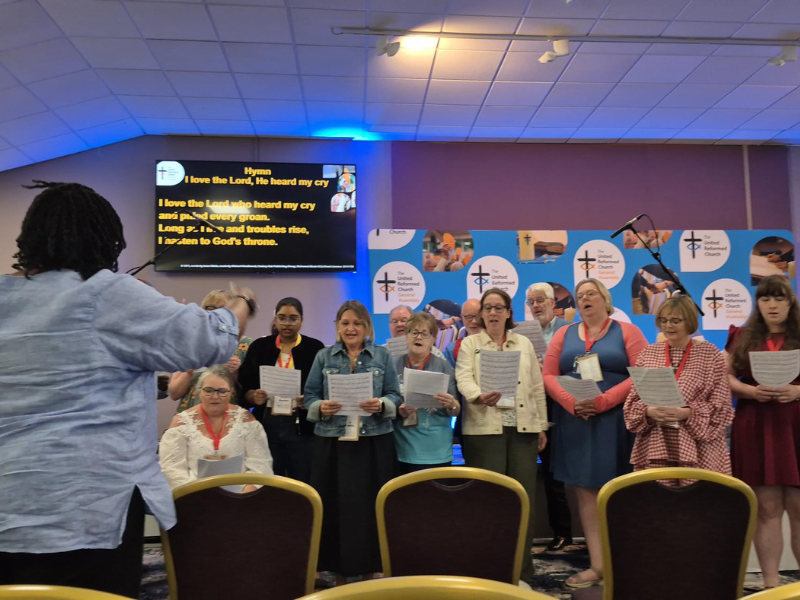
A special Assembly choir sang the hymn “I love the Lord who heard my cry”
Inauguration of Moderator
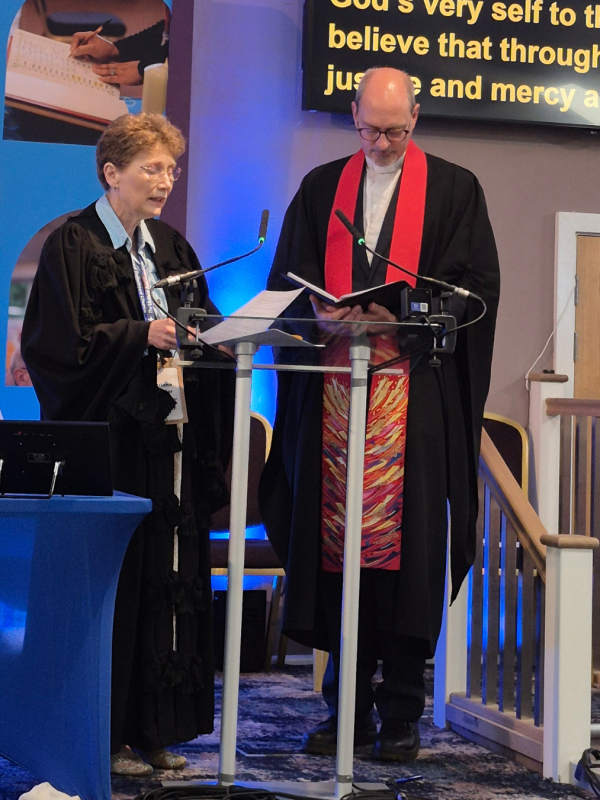
The Revd Neil Thorogood was inducted as Moderator of Assembly. His chaplain, the Revd Samantha Sheehan led worship.
The Revd Dr Doug Gay, Minister in the Church of Scotland and Senior Lecturer in Practical Theology at Glasgow University, preached on the resurrection appearance and catch of fish in John 21.
Doug likened the disciples’ night without a catch to the present moment in the life of the Church, and talked about a conversation he had had with a retiring Minister who felt like a failure. “There is a time to weep,” Doug said.
But in the Gospel story, Jesus showed himself. He told the disciples to cast their nets on the other side of the boat.
If someone tells us to cast our nets again, Doug said, we might get snappy: “Do you know how many things we’ve tried in this neighbourhood? We are all boat and no fish.”
Doug said to the URC, “If you are harbouring a sense of failure and loss of hope, today you’ve caught this story in your nets.” Jesus shows himself and calls us to do something new.
Doug cited the philosopher Charles Taylor saying that when as the public power of Christianity weakens, there comes a time when those who critiqued the old faith, they have to start telling their own stories and hosting their own rituals, and if young people find these secular improvisations too thin, they may look again at the faith their parents left. “Maybe that’s the moment the shoal moves.”
If we think we have already tried everything, we may find we haven’t been as good at change as we think. We may find the fish don’t stay in one place. We may find we need Jesus to show himself.
Doug pointed out those who serve in churches that the story contains a call from Jesus to feed his sheep, but before that he feeds us himself.
Doug concluded with three prayers from the Gospel passage, for the URC and for Neil: “Jesus lead us into change”, “Jesus feed us so we can feed others” and, above all, “Show yourself Jesus. Show yourself to us again.”
Neil signed the Bible of the General Assembly and was welcomed by the Assembly with warm applause.
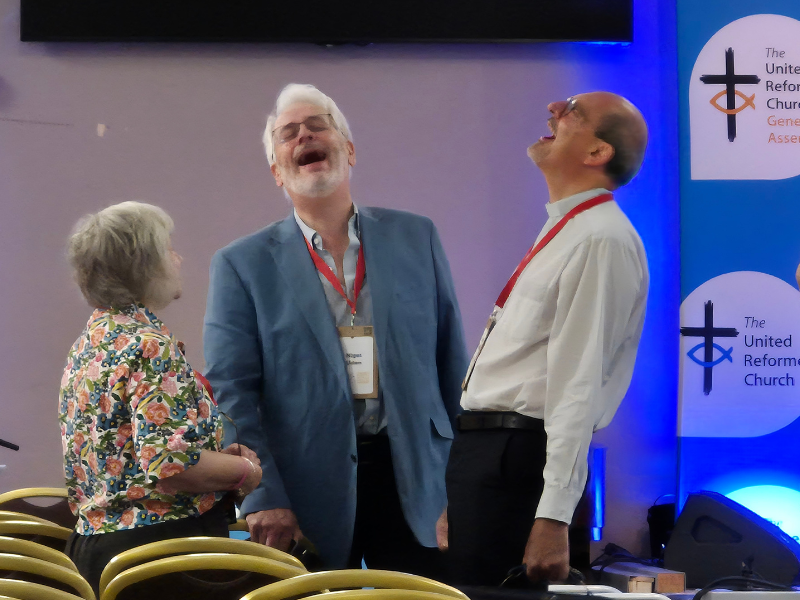
“A Merriment of Moderators”
Reporting team: Andy Jackson, Ann-Marie Nye, Steve Tomkins and Laurence Wareing. Photos and videos: Kevin Snyman and the team.