

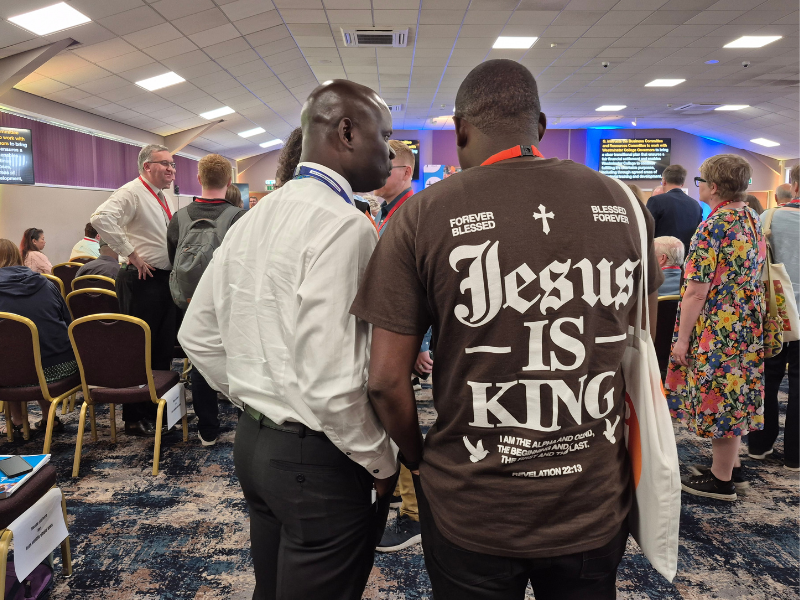
Day three of the 2026 meeting of the United Reformed Church General Assembly continued at The Hayes Conference Centre in Swanwick.
The Revd Dr Peter Green, Dean of Chapel at Lincoln Bishop University, led a second Bible study, this time on the story of the Syrophoenician woman who asked Jesus to deliver her daughter.
Fully accepting the great difficulty of the passage, Dr Green that when we cannot understand something in the New Testament it is often because we fail to understand the Old Testament background, and he outlined the connection with the story of Elijah and the Gentile Widow of Zarapheth.
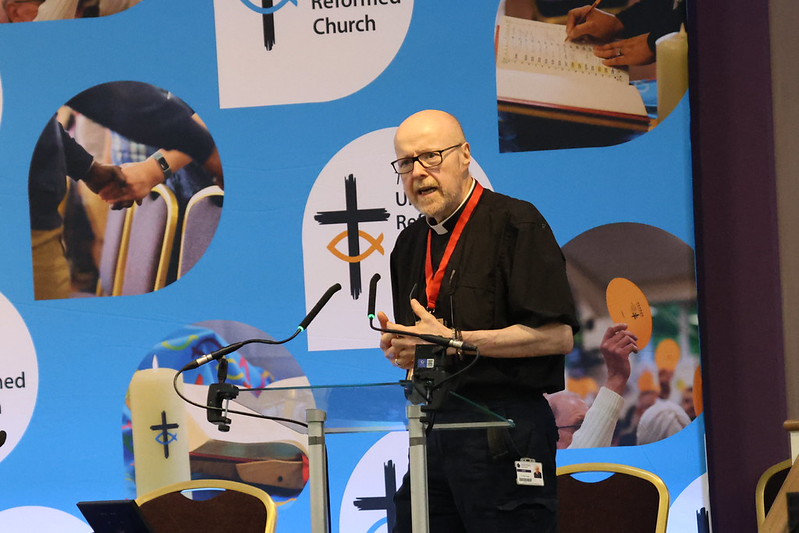
Dr Green asked members of Assembly whether they – like Jesus here – had we been confronted with a request for help, and said, ‘We can’t help these people, we have other priorities.’
Dr Green reflected on the way that worshippers in the Church of England have traditionally been invited to use the Syrophoenician woman’s words in Holy Communion, in the prayer known as ‘The humble grumble’: ‘We are not worthy so much as to gather up the crumbs under your table’. He said he has come to see the wisdom of inviting all people to say those words. In this chapter of the Gospel, Jesus has been condemning hypocrisy and the woman is the one without a shred of it. We must put aside hypocrisy and instead accept our solidarity with perpetrators of evil.
Session eight
Paper G2 – Nominations – List of Committees
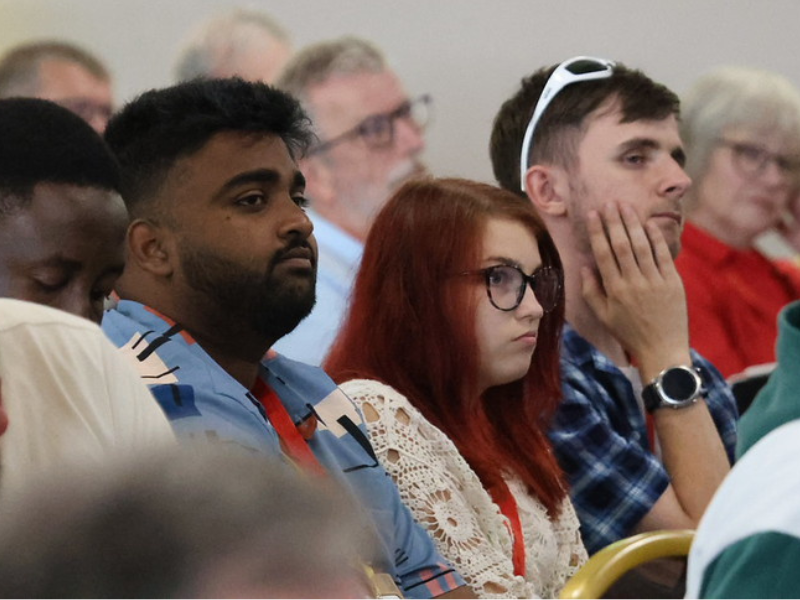
The Convenor or the Nominations Committee, Ms Victoria Blunt, spoke to Paper G1 – the Nominations Committee’s Report to General Assembly, which had been passed in the en bloc papers. Victoria wished to speak to two matters and to bring forward two further names as committee appointments.
- Victoria said that the process of recruiting Assembly-level committee members is now set up. She said there had been issues to iron out, but that the process is working well in the majority of cases. All roles at Assembly level must follow this process.
- She also spoke to the process of recruiting members of the newly-formed Church Life Fund (CLF) committee. General Assembly 2025 had directed that the committee should include a representative from each of the URC’s 13 synods, and that it should reflect the diversity of URC’s membership. Synods were asked to provide two names each, from which one would be selected in order to form a diverse group. However, Victoria said that of the 26 names put forward, only one nominated person was from a global heritage background.
General Assembly has instructed Nominations Committee to co-opt two more members to the CLF committee from a global heritage background in order to try to reflect the diversity of the denomination. But Victoria asked: Given Assembly’s discussions about Legacies of Slavery and anti-racism, how do we reflect our diverse memberships and heritages in our committee structures?
Assembly then vote on Resolution 16: the Revd Darren Holland appointed as a member of the FiA committee; and Resolution 17: Catriona Wheeler was appointed to serve as a director of the United Reformed Church Trust from 7 July 2026 to 6 July 2030.
Remaindered Business
A2 – Business Committee – A Fitness to Practice (remaindered from Session 4)
General Assembly welcomed the report of the Ministerial Disciplinary Working Group and affirmed the direction of travel towards a ‘Fitness to Practice’ process. A working group is developing a new process to replace the current ministerial disciplinary arrangements, aiming for a clearer, fairer, more consistent and legally robust system.
The work has widened from discipline alone to a broader ‘Fitness to Practice/Fitness to Minister’ approach, so that disciplinary, capability, competency and health-related concerns can be handled appropriately. Further policy and rules work has been commissioned from Ed Morgan KC, including a review of ministries policies and a revised draft framework to support a coherent new process.
“It’s right to do this right rather than at top speed, even though this is urgent,” John Bradbury, General Secretary, said before a presentation delivered by Dr Morgan.
Dr Morgan said that introducing a fitness to practise process is not about importing a secular disciplinary system into the Church, but about enabling the Church to fulfil its own mission with integrity. He stressed that ministers occupy positions of trust, and the Church must be able to demonstrate that it upholds the standards of behaviour it proclaims, protecting both those who raise concerns and those against whom allegations are made through fair, transparent and consistent procedures.
His speech highlighted how the nature of misconduct has evolved beyond traditional safeguarding issues to include online behaviour, financial exploitation and abuses of pastoral relationships. He warned that churches now face increasing scrutiny from regulators, insurers and the nation’s charity commissions (in England, Wales and in OSCR in Scotland), and that making robust governance is essential, not only to reduce the legal risk but also to preserve public confidence and the Church’s witness.
The proposed framework is intended to provide confidence, transparency, resilience and proportionality. It would establish clear procedures, ensure allegations are investigated fairly and evidence-based, safeguard the rights of both complainants and ministers, and reinforce that ministry is a privilege carrying accountability.
Ultimately, Ed said, such a process strengthens rather than restricts the Church’s mission by ensuring it lives out the values it proclaims.
Before adoption, the proposals will go through wider consultation and testing with Ministers, Church Related Community Workers (CRCWs), Moderators, Safeguarding Officers and others to identify issues and unintended consequences. Implementation, governance arrangements, guidance, training, support, transitional and adoption is now likely to be sought from General Assembly next year.
Paper I2 – Synod Safeguarding Reviews
Introducing Paper I2, Roger Jones, Convenor of the Safeguarding Committee, said the proposals would introduce a programme of safeguarding reviews across the URC’s synods to strengthen safeguarding policy and practice. He said similar quality assurance processes have become standard across churches, charities and social care organisations over the past decade and noted that both the Makin Review and the IICSA report had recommended robust systems of independent scrutiny, audit and learning. The proposed reviews are intended to embed those recommendations and support continuous improvement in safeguarding across the denomination.
Kerry Baker, Policy Development Officer for Safeguarding, acknowledged that the reviews would place additional demands on synods but said the process had been designed to strike a balance between gathering meaningful information and keeping the workload manageable. Drawing on two pilot reviews, she said the process would continue to be refined in response to feedback, with work already underway to streamline self-assessments, clarify expectations and improve scheduling. She also reassured Assembly that the process would reflect the different safeguarding legislation and policy framework in Wales. Kerry said the reviews would strengthen both safeguarding practice and the Church’s accountability.
During the information stage, Tim Crossley, Yorkshire Synod Clerk, sought clarification on whether General Assembly could “instruct” synods, whether the proposals would alter the Basis of Union by placing additional responsibilities on synods, and whether the financial implications understated the workload for already stretched synod staff. The Clerk of Assembly, Sarah Moore confirmed that the wording of the paper was in order.
During the discussion phase of the paper, members voiced support for the proposals. Graham Jennings informed that East Midlands was the first synod to take part, and although there was a lot of work, it was of benefit to the synod taking part.
Following a vote, Resolution 39 was carried. Before Assembly voted on Resolution 40, the Revd Dr John Bradbury, General Secretary, clarified that General Assembly has oversight of the synods and that its role in monitoring safeguarding policy and practice is explicitly set out in the Church’s governance. The resolution was passed.
In the Sunday Worship sermon at the 2026 URC General Assembly, the Revd Geoff Felton, Moderator of the Mersey Synod, challenged delegates to reflect on what the Holy Spirit has been saying during the Assembly, and encouraged them to carry that vision back to their local churches.
While much of the work of the Assembly reflects on the church’s past, Geoff urged the church to look to the future with hope. He said that reports of the church’s decline are exaggerated. He cited the projects shared as part of the Community Project Awards as examples of how the church is flourishing.
Drawing on Jesus’ words in Matthew, he emphasised that the church’s future rests not on human leadership, management or strategy, but on the identity and lordship of Jesus Christ. Peter’s confession that Jesus is the Messiah is the foundation upon which Christ promises to build his church. The church’s calling, therefore, is not to build a larger institution but to be a faithful one. “Chill out! … Size doesn’t lead to faithfulness, but faithfulness leads to size.”
The sermon encouraged a broader understanding of the church. Although many congregations in the UK are closing, this should not be seen as the death of the church. Christianity continues to grow across much of the Global South, and local church closures can be reframed as a mission that has been “completed” rather than one that has failed. There are even some URC’s that are growing.
Turning to Ephesians (where in Ephesus, the church no longer exists), Geoff described the characteristics of the future church. Leadership exists not simply to perform ministry but to equip others for service, creating a community where “everyone gets to play.” Every Christian has gifts to contribute, and leaders should be asking both who they are equipping and how they themselves are being equipped. “How is your equipping going, and let’s flip that – how are you being equipped? We are called to equip one another.”
He stressed that maturity in Christ comes through growing in the knowledge of Jesus. Such maturity enables Christians to resist being swept along by cultural trends or social media narratives. Geoff contrasted the gospel’s message of hope and identity with popular culture, citing songs like Critical Thinking by the Manic Street Preachers, and Trash by Suede, that reflect cultural confusion, superficiality and hopelessness.
Against song lyrics and messages that people are “trash” or should simply “live their truth,” Christians proclaim that every person is created in God’s image, loved by God and given purpose in Christ. “Ephesians calls us God’s workmanship… look at you, you may not be as young as you used to be, you might be falling off the conveyer belt, but you are God’s work of art. However difficult life might be for people, there is a God that loves them.”
In conclusion, he reminded the Assembly that Christ alone is the head of the church. The church belongs neither to governments nor denominational leaders, but to Jesus himself.
Session nine
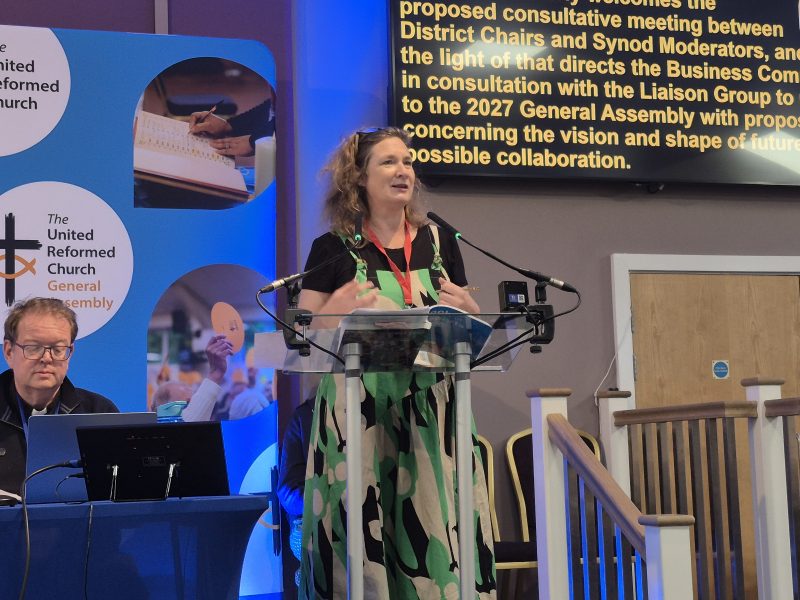
Paper AB1: Business/Faith in Action Committees – URC/Methodist Liaison
This paper was brought jointly by the Business and Faith in Action Committees. The Convenor of Faith in Action, Sarah Lane Cawte said Resolution 4 builds on existing cooperation between the Methodist Church and United Reformed Church, proposing a consultative meeting of Methodist District Chairs and URC Synod Moderators and directing the Business Committee in consultation with the liaison group to report to the 2027 General Assembly with proposals concerning the vision and shape of future possible collaboration.
She noted that the Methodist and URC offices are now “handily located near each other” (both now in Tavistock Place in London) and that there are around 200 Methodist/URC Local Ecumenical Partnerships. She added that the discussions would consider how collaboration could be strengthened without making firm commitments, and at a low cost. Sarah said that the paper “promotes unity, reciprocity and effective stewardship while ensuring that any future proposals are carefully considered and brought back to GA for consideration.”
She added that Methodist Conference passed the same resolution earlier this week.
In discussion, Reuben Watt, East Midland, quoted the Statement Concerning the Nature, Faith and Order of the URC, which speaks of the “visible unity of the Church”. He said Assembly had been honest about challenges it faces and had acknowledged membership decline; but wondered whether, in speaking about collaboration with the Methodist Church, Assembly was thinking broadly enough. Are we setting our sights high enough? Reuben asked; might 2027/2028 be the year when instead of further collaboration, we ask whether the Methodist Church and URC become one?
The Revd Lindsey Sanderson had represented the URC at this year’s Methodist Conference. She asked Assembly the same question she had asked there – a question borrowed from the Australian Churches Covenanting Together Process. “What is possible if we go to the limits of what is permissible.” She said, there is already much that is possible, “but I am firmly of the opinion that there is more that is permissible. So my hope and prayer for this consultative meeting is that we can begin to discern an answer to this question.”
The Revd John Bremnar, Ecumenical Officer for the National Synod of Scotland, spoke of his experience of working with the Waldensian Church in Italy in the 1990s; formally, “the Union of Waldensian and Methodist Churches”. Their pact of integration was a not a way of uniting the Churches in a way that erased their identities. The Waldensian Church remains Waldensian, he said, and the Methodist Churches conduct their business in a very similar way to Methodist Churches in Britain. But for all practical purposes they are one Church. He said there was a possibility in the proposal before Assembly that the URC and Methodist Church each retain their identity but be one in ministry and membership.
The Revd Tom Osborne, the Methodist representative, affirmed the benefit of the conversations. He wasn’t sure that full unity should be on the agenda, but he agreed that what was possible should be fully explored.
The Revd Dr Kirsty Thorpe, a former Moderator, reminded Assembly that “we’ve been down this path before”. She said the URC’s Mission Council and Methodist Council had met together in joint sessions – “large, visionary gatherings” – and endeavoured to lay foundations for further work. However, “we did look at buildings and how they can be used as platforms for mission together, but the other work we hoped to do went into the sand”. Quoting the report, she emphasised that the new proposed conversations should avoid “becoming immersed and lost in process and technicalities”. She also reminded Assembly that the Methodist covenant with the Church of England (CofE) is “a complicating factor for all of us”.
The Revd Dr Romily Micklem also pointed out that the Methodist/CofE covenant was most successful at a national level, but his experience was of churches locally that “behaved as if they’d never even heard of it outside of the [Methodist] circuit meeting”. We have to take the local with us, he said – it can’t be something that just happens at Assembly and synod level. “Don’t just look at the opportunities; we have to be realistic and open-eyed.”
The General Secretary, responding for the Business Committee, said Reuben had called Assembly to a central point of who we are. But he also said, “We’ve done quite a lot of growing up” and asked how we institute the vision of unity. He warned that if we set full unity as our goal, “we will do nothing else for the next 20 years”. He said the Waldensian example was a helpful one. He also said that one of the shadow sides of the formation of the URC was that “we ripped from underneath people their identities”. He noted that there are cultural differences between the Methodist and URC denominations – “and those are the things that can trip us up if we’re not careful”.
Ms Lindsey Brown, Head of Ecumenical Relations and Ecumenism, welcomed the warmth of contributions to the discussion. She spoke of the existing sharing of facilities management and times of prayer between Methodists and the URC in Tavistock Place, but she agreed that there can be complexities at a local level.
Resolution 4 was carried.
Paper P5: West Midlands Synod – Clarifying “pastoral necessity” for lay presidency at the Sacraments
Presented by the Revd Steve Faber, Moderator of West Midlands Synod, Paper A5, containing Resolution 60, highlights that the URC’s current guidance on lay presidency at the sacraments no longer reflects the realities of ministry. Since General Assembly last reviewed the policy in 2016, the number of churches served by each stipendiary minister has increased significantly — now an average of 1 to 5, whereas in 2016, it was 3.2 — making it increasingly difficult for ministers to preside at each of the churches they serve where the most common pattern for Communion is monthly, without factoring in ministers’ annual or study leave.
While paying tribute to the contribution of non-stipendiary and retired ministers, he said many congregations are finding it a harder to secure authorised sacramental presidency and that the need for lay presidency is growing rapidly. The West Midlands Synod’s Ministry Development Committee is also receiving an increasing number of requests to appoint Authorised Elders. Therefore, the paper essentially asks for clearer guidance on what constitutes “pastoral necessity” when authorising elders to preside, so that decisions are transparent, consistent and reflect the realities of ministry across all synods.
Steve posed questions such as: What defines that necessity? How should we manage a Minister being expected to preside at four or five Easter morning Communions, or Christmas Eve services many miles apart?
Following a brief discussion, Resolution 60 was carried.
Session Ten
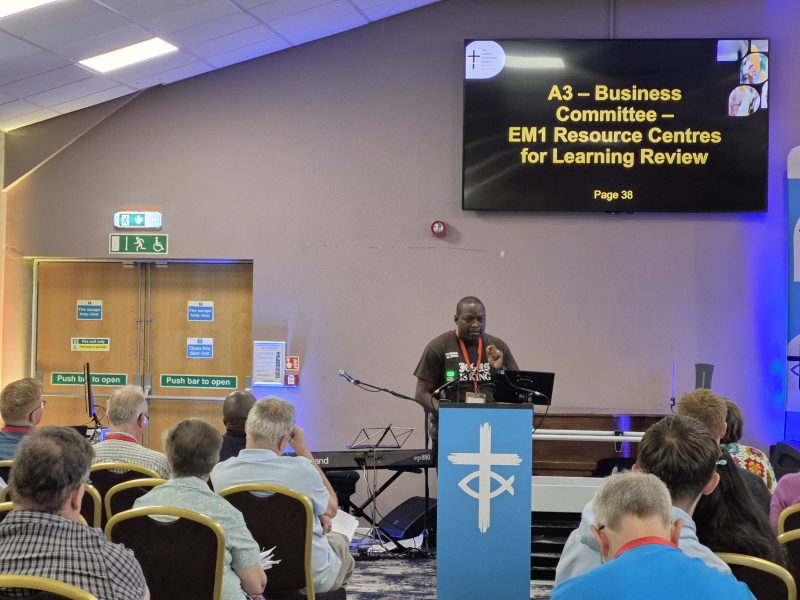
Paper A3: Business – Resource Centres of Learning – Education for Ministry Phase 1
This session followed on from the initial presentations made on Saturday morning, with questions for clarification.
In response to several questions, the Revd Dr John Bradbury, the General Secretary, said:
- The resolution would be taken as a whole, in order to ensure that the package of recommendations forms a coherent whole
- The reason for recommending having two RCLs, not one, derives from the two pedagogical approaches embedded in Luther King Theological College (LKTC) and The Scottish College, and the hope that increased collaboration between the two would strengthen their shared approaches.
- Regarding the future of Westminster College, he said it wasn’t immediately possible to say whether the URC would continue as “partners” or “customers” of the college – “neither approach is ruled out”. He said there was good reason to believe that partnership would be ongoing, but that the precise shape of that would have to be worked out. He acknowledged that though the report explicitly deals with EM1, the desire to integrate as many strands of learning as possible suggests that it may also be logical for the RCLs that deliver EM1 to also deliver EM2, but this report does not specify that. He could envisage Westminster College making offerings for EM3. Westminster would continue as an RCL at the moment.
Moving to the discussion stage, the Moderator invited those who have a direct conflict of interest to speak first before recusing themselves.
The Revd John Bremnar, who is on the Board of Trustees of The Scottish College, noted that the difference in the numbers of students at LKTC and the Scottish College was not huge, despite the use of the terms “primary” and “complementary” (which he suggested could be misleading). Dr Bradbury said that the main difference between the two institutions was the balance of resources required to maintain them.
Those who have a direct conflict of interest recused themselves before further discussion.
Lythan Nevard, Moderator of Eastern Synod, noted that only one candidate for stipendiary minister would begin training next year. She said that, as a denomination, we have not done enough to raise up potential candidates. She also said that to candidate for stipendiary ministry, an individual has to be under 54 – which of our churches, she asked, has members who are under that age who are being discipled to candidate for ministry?
Simon Cross, Yorkshire, argued that the report was of insufficient quality and detail to be the basis for the Assembly’s decision-making. He asked: if the assumptions in the report “are presented as facts, how can we accept its conclusions?” He said the transitional arrangements are not defined but would be complex; and wondered how Westminster would continue to fulfil its charitable purposes?
Mr Cross proposed an amendment to Resolution 2, Section G: “Assembly instructs the Business Committee and Resources Committee to work with Westminster College Governors to bring forward a clear transitional plan that ensure a fair financial settlement and enables Westminster College to continue fulfilling its charitable purposes, including through agreed areas of ministerial training and development, and to continue to play a full part in the Cambridge Theological Federation.”
The proposed amendment was ruled out of order due to its financial implications which had not been discussed with the relevant committee.
In response to questions to date, Dr Bradbury said that the outcomes of this review could alter the balance of the identities that make up the United Reformed Church, and that the Church would have be to be alert to this in a very intentional way.
He argued that financial modelling is different from presenting facts; and he said he hadn’t heard any inaccuracies pointed to outside of that.
Alan Yates, the URC Treasurer responded to financial questions. He said that while he couldn’t guarantee that the remaining RCLs would flourish as a result of the proposals, the modelling done so far gave him hope. For the record, he said that there had been a difference of opinion over the modelling, and he also that he was never given any data about Westminster College fundraising.
A member of Thames North Synod feared for Westminster’s future – he worried that if the report was accepted, Westminster would soon be recorded in Assembly’s list of closing buildings.
The Revd Dr Charles Baczyk-Bell, the Church of England representative, thanked Assembly for its courage and realism. He said the CofE is having to make its own difficult decisions about theological institutions and that for too long “we’ve had our head in the sand”. He said that he hoped his own Church would learn from the URC’s deliberations.
Pfarrer Martin Henninger, Evangelische Kirche der Pfalz, spoke about his own experience of learning at Westminster. He said Cambridge is one of the best universities in the world – did the URC want to walk away from that; he said people at Cambridge would be forming the future of the country – was it not important for the URC to meet those people? In response, Dr Bradbury said that Cambridge’s reputation did not mean that other institutions didn’t also give excellent experiences for those training for ministry and for engaging with the public square.
Dr Bradbury agreed with the Revd Liz Adam, who took CRCW and Stipendiary modules at Northern College, that we can’t ignore the need to make brave choices – just as we say to local churches they must consider hard choices about moving out of, or closing, their buildings, we should be addressing our RCLs, with their “sub-standard accommodation”. She suggested that, from a carbon footprint point of view, Cambridge is the least easy location to reach without a car.
The Youth Moderator-Elect told Assembly that six young people had spoken to him in recent months about their interest in training for ministry but that he couldn’t say to them that there were flourishing RCLs for them to train at; that he also had to say that they would be training into a very fragile denomination.
The Moderator of Mersey Synod, the Revd Geoff Felton, spoke in part as a governor of Liverpool Hope University, which has recently cut to delivery theological training. He said he was listening hard to the debate and was wavering about how to vote. He was fearful that the “breadth of our theological education will be diminished”. He said that underlying the paper is a question about discipleship – why do people no longer eel called to ministry? – it is a question we need to address, he said. Responding, Dr Bradbury reflected on the contracting theological education. He didn’t quite believe the contribution of non-conformist training colleges was no longer required. Her referred to comments by the Revd Aled Jones, Thames North Synod, who had been trained in Welsh Independence College – he said he had preached at its closure in 2022, but he now brought a word of hope. He had recognised that a long season had come to a close; nevertheless, that didn’t mean God was done with ministerial formation – training has carried on in another way. However, Dr Bradbury did question the wisdom of relying on universities for a full theological grounding and training for URC ministers – he wasn’t convinced this would always be available. The Revd Sally Bateman has benefited from the support of all RCLs during her doctoral training. Her concern was that Assembly was being asked to make a decision based on a report with serious issues; that insufficient weight had been given to the location of Westminster College – she spoke of a “soft power” benefit to being associated with Cambridge University. To leave Westminster might also lead to a weakening of ecumenical relations, she believed. She also felt that the criteria included in Paper A3 did not match the criteria set out by 2025 General Assembly; Dr Bradbury responded that the panel’s criteria accurately incorporated the requirements of the Minutes of 2025 General Assembly.
The Revd Dr Susan Durber, who has taught at LKTC and is a former Principal of Westminster College, proposed an additional paragraph (Section H.) to the resolution:
“Mindful of the need for our Resource Centres for Learning to have a strong complement of URC staff, encourages the Resources Committee [later amended to read “relevant committees”] and the RCLs to work together to ensure a flourishing URC presence in staff teams and thus a continuing URC contribution to theological education.”
Dr Bradbury said this amendment reflected a concern that had been felt by the panel, and he said the panel would accept Dr Durber’s amendment, with the change indicated above.
The Revd Dr Romilly Micklem said, “If we wait for complete evidence, we may wait a very long time.” He added that that there has always been over-capacity for URC students; and shared his concern about the money that will be required to look after Westminster’s Grade II Listed Building. Other speakers also contributed their own personal experiences of both training and spaces before the Moderator tested the mind of the Assembly.
On a vote, Resolution 2, including the addition of a new Section H, was passed.
Resolution 3 was also carried.
Both before and following the votes, the Moderator’s chaplain led Assembly in prayer.
Memorial for Deceased Ministers and CRCWs
The General Assembly remembered the Ministers, Church Related Community Workers and others who had passed since its last meeting. The Revd Nicola Furley-Smith, Deputy General Secretary (Ministries), read out the names and the Chaplain to the Moderator, the Revd Jane Wade, led prayers.
Peter Digby Ball
Robert John Blows
Colin George Bones
Elizabeth Jean Brown
Janet Calderley
John Mackenzie Chisholm
Malcolm Bernard Clarke
John Cranley Cohen
Kenneth Mervyn Coles
Meryl Court
Peter Charles Cruchley
Graham Herbert Dadd
Robert Francis Damer
Lillian Evangeline Dean
Myra D Dillistone
John Colbeck Durell
Richard Eastman
Alan Frederick Theodore Evans
Mary Elaine Elizabeth Frost
James Ronald Garfitt
Richard Hambly
Kenneth Harris
Keith Leonard Havers
Geoffrey Herickx
Malcolm Hill
Alwyn John Knight
Michael John Lay
Lesley Anne McNeil
Elizabeth Denise Megson
David John Netherwood
Robert Freeland Philip
Barbara Plenderleith
Derek Charles Redfern
Michael James Rigney
Anthony Tony Ritchie
Geoffrey Smith
Michael John Bemrose Spencer
John Alan Stanyon
Brian Sadler Stone
Harold Robert Tonks
Valerie Ann Towler
John Wadhams
James Norman Walker
Robert John Way
Stephen Alexander Wilkins
Alan Frederick Edward Wise
Ambrose David Wright
Giving thanks for the life of churches that have closed
The General Assembly gave thanks for the life of churches that had closed, or had ceased being a Local Ecumenical project, since the last meeting. Prayers for the life and mission of those churches were shared by the Chaplain.
Synod 1 – Northern Synod
St Cuthbert’s Heaton LEP, Newcastle-upon-Tyne, 31 August 2025
Synod 2 – North Western Synod
Edgeley Community Church, Stockport, 14 February 2026
St Peter’s Church LEP, Manchester, 14 December 2025
Synod 4 – Yorkshire Synod
Lowedges, Michael Church, Sheffield, 28 February 2026
Riddlesden United Reformed Church, Keighley, 31 January 2026
Synod 5 – East Midlands Synod
Trinity United Reformed Church, Lincoln, 31 January 2026
Harrold & Carlton LEP, Bedford, 31 December 2025
Oadby United Reformed Church, Leicester, 29 March 2026
London Road United Reformed Church, Kettering, 31 March 2026
Synod 6 – West Midlands Synod
Baxter United Reformed Church, Kidderminster, 31 August 2025
Synod 7 – Eastern Synod
Southchurch Park United Reformed Church, Southend-on-Sea, 28 March 2026
Synod 8 – South Western Synod
Martock United Reformed Church, Martock, Somerset, 3 August 2025
Curry Rivel United Reformed Church, Curry Rivel, Somerset, 1 June 2025
Synod 9 – Wessex Synod
Hope United Reformed Church, Weymouth, 22 February 2026
Wonersh United Reformed Church, Wonersh, Surrey, 19 October 2025
Synod 11 – Southern Synod
Pagham United Reformed Church, Pagham, West Sussex, 29 November 2025
Synod 12 – Wales Synod
Tabernacle United Reformed Church, Holywell, Flintshire, 30 September 2025
Tabernacle United Reformed Church, Llanvaches, Newport, 7 December 2025
Synod 13 – Scotland Synod
Hamilton United Reformed Church, Hamilton, 28 September 2025
Greenock West United Reformed Church, Greenock, 31 December 2025
Celebrating Jubilee Ministers
The Revd Nicola Furley-Smith, Deputy General Secretary (Ministries), led Assembly in celebrating ministers who have marked significant periods of service:
Celebrating 70 years of ordained ministry in 2026:
Robert William Courtney, Charles Knowlson Meachin, David Stollery Morris
Celebrating 60 years of ordained ministry in 2026:
Clabon James Allen, Robert Andrews, David Batchelor, Michael John Cruchley, David Murray Cuckson, Lesley Gordon Giller, Rosemary Ruth Hartley, Glyn Jenkins, Kenneth William Marsh, Hugh Nixon McKee, Donald William Norwood, Leonard Rees Phelps, David Alistair Pratt, Rodney Alan Ward, Leonard John Wigg, David Wiseman
Celebrating 50 years of ordained ministry in 2026:
Derek Corner, Jack William Dyce, Brian O’Neill, David Raymond Peel, David Trafford, Elizabeth Anne Welch.
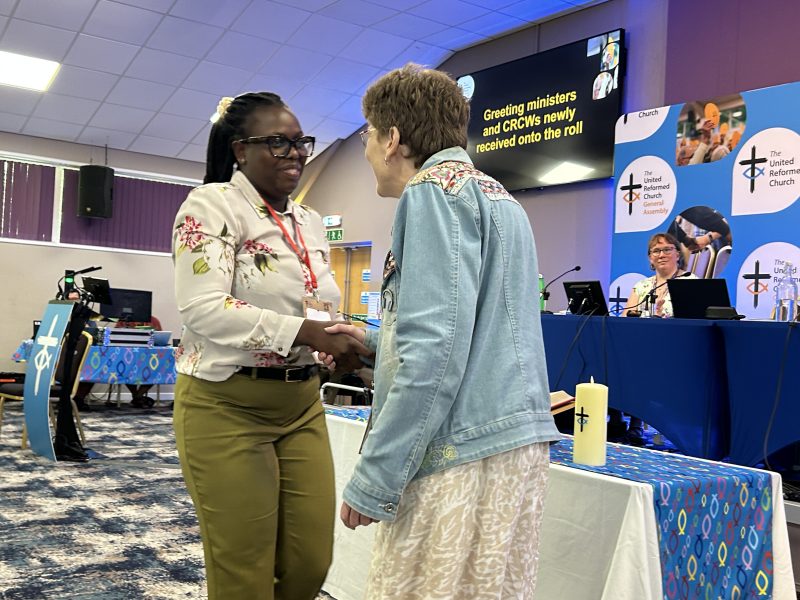
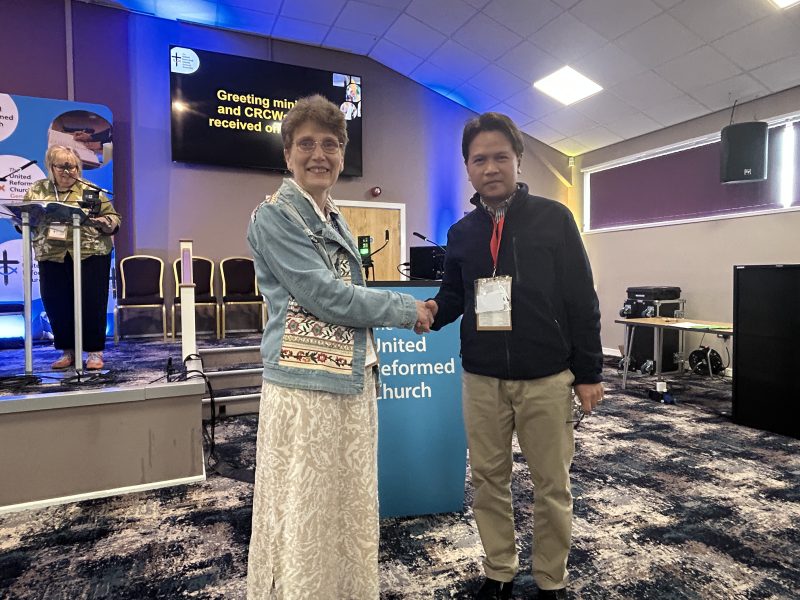
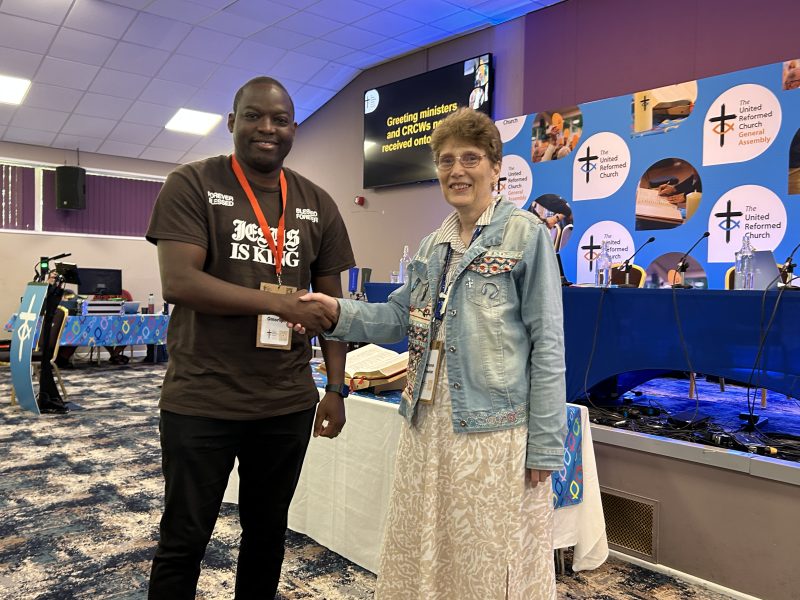
Greeting ministers and CRCWs newly received onto the roll
Nicola listed those who have been admitted to the Roll of Ministers of the Word and Sacraments, 1 April 2025 to 30 April 2026
By ordination and induction: Margaret Elizabeth Dexter-Brown, Susan Ann Knight, Clare Nutbrown-Hughes, Maurice Philips Omorojie, Tina Louise Wilson
By transfer from other Churches: Packiaraj Asirvatham (Church of South India), Juan Cruz (Presbyterian Church in the Philippines), Nomaqhawe Marambi (United Church of Zimbabwe)
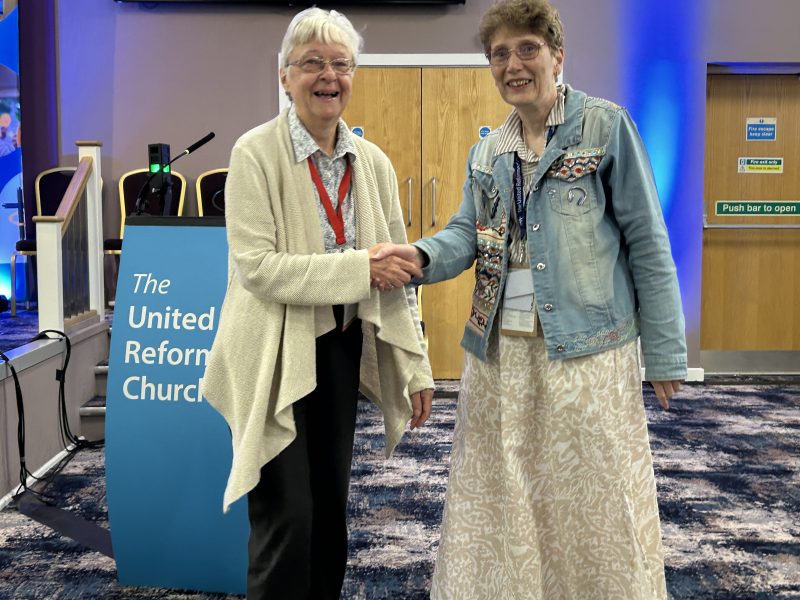
The Moderator greeted the Revd Elizabeth Welch on her 50th Anniversary of Ordination, the Revd Maurice Philips Omorojie on being Ordained and Inducted as a new Minister, the Revd Juan Cruz after his transfer from the Presbyterian Church in the Philippines, the Revd Nomaqhawe Marambi after her transfer from United Church of Zimbabwe, the Revd Dr Phil Wall, the new Head of Ministries Learning and Development, and Dr Jo Griffiths, the new Head of Children’s, Youth, Intergenerational and Discipleship.
Session eleven
Synod Moderators’ Report: (Extra) Ordinary Hope
Lythan Nevard, Moderator of Eastern Synod and Geoff Felton, Moderator of Mersey Synod, presented an invitation to reflect on our hope in Jesus and on where we can bring God’s hope into the world today.
Their report said, ‘Hope is rooted not in the achievements of individuals or human institutions but on the character and promises of God as fulfilled in the life, death and resurrection of Jesus Christ.’
Lythan said that ‘hope’ was a word we had heard more than any other through General Assembly – apart from Moderator.
Other synod moderators shared their idea of what hope is, including:
- Something beyond our imagination
- Sharing the unconditional love of God
- What we have to share with broken world
- Found in Jesus
- God’s kingdom coming on earth
- Participating in what God is doing
The Moderators invited Assembly, and local churches, to discuss:
- If we say we put our hope in Jesus, how should this shape how we live?
- How can we demonstrate that we are hopeful people?
- What does hope look like in your context?
- What does it mean to let go of what is known, with hope?
The Moderators’ report is here
The meeting then closed with prayers and worship.
Reporting team: Andy Jackson, Ann-Marie Nye, Laurence Wareing and Steve Tomkins.