

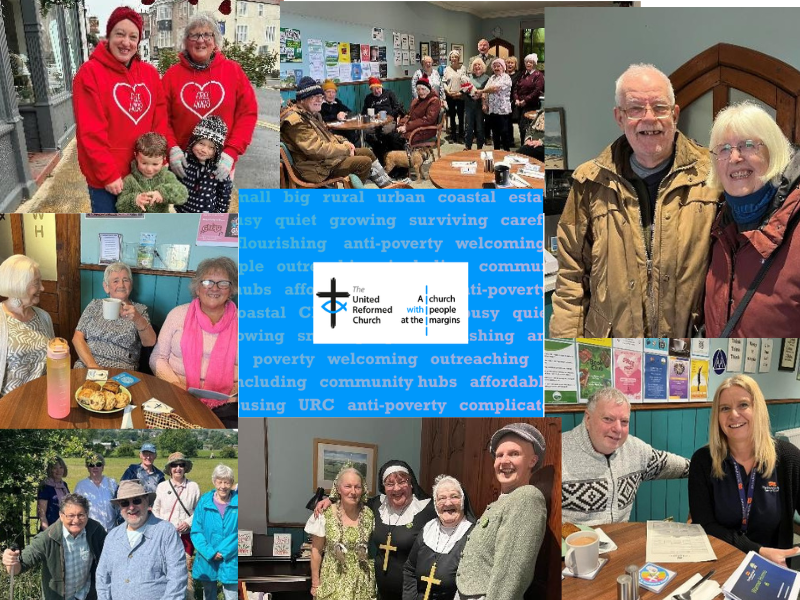
Seventy-four people attended the first in a series of webinars to help congregations become places where people at the margins are loved, nurtured and empowered.
Hosted by Roo Stewart, Head of Public Issues, in collaboration with Mike Hart, Transformation Director for North Western Synod, the first webinar, held on 16 February, explored themes such as how church growth and engagement with people at the margins are not competing priorities, but complementary.
The session started with a welcome by Roo, followed by an introduction by Jenny Mills, Deputy General Secretary (Faith in Action) who shared about some of the changes that have taken place at Church House, the Offices of General Assembly.
Referring to the Church Life Review and how the United Reformed Church (URC) is charged with being part of local communities and addressing issues of injustice and hurts, Mike reflected on Jesus’ encounter with the Woman at the Well (John 4:1-30). He then invited the attendees to reflect on two questions in small groups:
- In what ways does this story challenge the religious assumptions of the time?
- What might this say to us about working with people at the margins in our local community?
In exploring the questions, Mike challenged people to think about not only what the passage might have to say to us about working with people at the margins in local communities, but how such work could help develop and enhance our life as a worshipping and witnessing Christian fellowship.
Fliss Barker, Church Related Community Worker for Wooler URC, in Northumberland, spoke about the importance of listening to people who are “poverty experienced”. “In their lives lies the best understanding of poverty,” she said. “What we do is based on active listening: learning first, then walking alongside.”
In rural Wooler, Fliss has helped develop Warm Welcome sessions, street presence initiatives, school engagement and run Alpha groups, all rooted in relationship-building. She and members of her congregation even offered free hugs on the high street on Valentine’s Day.
“It takes time,” said Fliss. “I spent months just walking the high street, listening. Presence matters.”
In a second small group session, participants explored the following two questions:
- Where do you see challenges for your church and community? How can listening to people in the community help you tackle those challenges together?
- How might listening to your local community challenge your ideas of church growth and success and how this is measured?
Themes generated were along the lines of inclusion and accessibility; from access to food and everyday essentials to a church ramp placed centrally rather than hidden away.
“When we make space accessible to some,” one participant reflected, “it becomes more accessible to everyone.”
The traditional measures of church growth were challenged, suggesting congregations might look beyond Sunday attendance figures. A short video about the Dandelion Community was highlighted as an example. The community is also used as an example for the Church Urban Fund’s “Growing Good” toolkit [free; requires sign-in].
“Many of the churches most active in their communities are also seeing growth,” said Mike. “But perhaps we also need to measure things like volunteers, partnerships, and the number of people coming through our doors through the week.”
Fliss echoed this, reframing growth as discipleship and relationship-building.
“My job is never about putting bums on seats,” she said. “It’s about growth in people. The conversations happening across our community, that’s kingdom building.”
Neil Cooper, reflecting on research into church presence in low-income communities, acknowledged a mixed picture. While many denominations have closed more churches in economically marginalised areas, he described a powerful counter-narrative: “Where we listened, people spoke with passion about church as family; a place of love, belonging and faithful presence.”
“Church at the margins,” he added, “is not a story of failure. It’s a story of incredible witness and mission”.
Speakers emphasised that engagement often begins simply, through hospitality, listening and patience. Warm Welcome spaces, small grants, chatty cafés and partnerships with multi-faith communities were highlighted as practical starting points.
“Start simple,” said Mike. “A cup of tea can open the door to something much bigger.”
The overall message was clear: patient, faithful presence in local communities is not separate from church growth, it is growth.
Three more webinars remain in the series and take place on the following dates:
Pre-register for the 11 May 2026 webinar.
Pre-register for the 10 August 2026 webinar.
Pre-register for the 16 November 2026 webinar.
Once registered, please expect an email confirmation which will include further details on how to join the meeting.