
URC Crisis Communications Plan
A free guide to crisis communications for churches.
Crisis communication is an essential element of disaster ministry. A little bit of preparation now can go a long way in ensuring everything goes more smoothly at your church when disaster strikes.
This plan aims to support the Offices of General Assembly, Synods, local churches and staff in dealing with a media crisis, identifying key appropriate contacts, and a strategy for agreeing media statements.
Download this guidance
- The URC Crisis Communications Plan (PDF | 686kb)

Crisis Communications at a glance
(For anyone worried about an issue reaching the media, becomes aware of a crisis or is contacted by the media)
First things first
- Stay calm. You are not expected to deal with this alone
- Timing is essential. Never ignore an issue and hope it will go away
- Your role is to pass information on quickly and accurately
If the media contacts you
- Do not answer questions or give opinions
- Simply say: “I will find the best person for you to speak to.”
- Record the reporter’s name and outlet, phone number and email, their query and their deadline
Tell the right people
- Activate the appropriate Crisis Response Team (local, Synod or Offices of General Assembly)
- In all instances, contact the URC Communications Team by calling 07976 753 950 (24-hour availability) or 07342 883 954.
Do not post or comment online
- Do not post on social media or reply to messages, share personal views or unapproved updates
- Wait for an agreed statement or use an approved holding statement if advised
Key things to remember
- Stick to confirmed information only
- Do not name individuals or share personal details
- Use calm, compassionate language
- What you say publicly reflects the whole URC
Care comes first
- Prioritise pastoral care and safeguarding
- Open the church for prayer or reflection if appropriate
- Ask for support if you feel unsure or overwhelmed
Remember: You don’t need to fix the situation - just pass it on promptly and responsibly.
Crisis communications
Why do we need a Crisis Communications Plan?
In 2018, Theos Think Tank published its After Grenfell: the Faith Groups’ Response report. The report shows that in the wake of a horrific tragedy, the role of faith groups in the community stands out. It reports how “churches, mosques, synagogues, and gurdwaras all stepped up to the plate, responding practically, emotionally and spiritually to a moment of pain and confusion”.
These faith groups acted as evacuation areas, received, sorted and distributed donations, offered accommodation, drew up lists of the missing, supported emergency services, patrolled the cordon, counselled and supported survivors, provided space for prayer and reflection, and hosted interfaith services of memorial and lament.
Faith groups were able to respond the way they did because they are trusted, embedded into the communities they served, are long-standing institutions, and committed.
The report explores the experience of these faith groups in dealing with such a tragedy and highlights three things, that faith groups need to be: prepared, visible and flexible.
Defining a crisis
Faith groups can feature both positively and negatively in the media.
A crisis could be a large-scale community/national/international tragedy that churches would want to support the community in dealing with/responding to.
However, it is also any event that can cause reputational harm to the United Reformed Church (URC) and places its values on trial in the court
of public opinion.
If an incident occurs that has the potential to generate negative media interest, this Crisis Communications Plan will ensure that staff are well supported, can follow media protocols, alert appropriate colleagues and agree a key message statement for media outlets to publish.
This plan is also a good practice guide as to how to respond to community tragedies using social media, your website, and how best to organise volunteers.
Examples of reputational harm crisis scenarios
- Staff issue – eg a staff member has accused their employer of bullying and reported the matter to the press
- Safeguarding issue – an allegation involving a URC member of staff/volunteer or staff/volunteer of an organisation using URC premises has
been made - Property/manse issue – a tenant has been issued an eviction notice and reported the matter to the press
- Finance/fraud issue – someone has allegedly been misusing church funds
- Community issue – a church is closing, and the local community group can no longer use the premises for its activities and reported the matter to the press. A staff member/volunteer of an organisation using church premises has been arrested and is due to appear in court. Church split over allowing same sex marriages.
Examples of community/national/international tragedies
- Manchester Synagogue attacks
- Southport attack
- Grenfell
- Shoreham Airshow crash
- Kings Cross Fire
- 7/7 bombings
- London Bridge terror attacks
In all circumstances, the URC Communications Team, based at the Offices of General Assembly, should be included as a first port of call for advice,
information and guidance. The details for contacting the team are in the table below. They are trained and ready to assist you in whichever way helps.
Sharing good news
If any church has positive news to share, eg it is featuring positively in the local media, radio or TV, it is good practice to alert the URC Communications Team so it can share your good news across the national website and/or social media networks.
Key contacts
Immediate Crisis Response Team (IRCT) - Synods and Local Churches
Synod Moderator
Minister
Lay leader
Local church Safeguarding coordinator (safeguarding issues only)
Synod Safeguarding Officer (safeguarding issues only)
Ann-Marie Nye - URC Communications Officer 0207 520 2715 or 07976 753 950 (out of hours) or email [email protected]
Laurence Wareing - URC Communications Officer 07342 883 954 or email [email protected]
In the absence of Ann-Marie and Laurence, please contact:
Andy Jackson - URC Head of Communications 0207 691 9865 or 07976 848 062 or email [email protected]
Expanded Crisis Response Team (ECRT) - Synods and Local Churches (situation dependent)
Synod Clerk
Key Elder
Synod Property Officer
Synod Treasurer
Revd Dr John Bradbury - URC General Secretary 020 7916 8646 or email [email protected]
Sharon Barr - URC Head of Safeguarding 07776 178 246 or email [email protected]
In the absence of the General Secretary, include a Deputy General Secretary or the Chief Operating Officer.
Revd Nicola Furley-Smith - URC Deputy General Secretary (Ministries) [email protected]
Revd Jenny Mills - URC Deputy General Secretary (Faith in Action) [email protected]
Victoria James - Chief Operating Officer 020 7916 2020 or 07930 851 061 or by email [email protected]
(Update these details every six months)
Crisis Response Team for the Offices of General Assembly (CRTOGA)
Andy Jackson - URC Head of Communications 0207 691 9865 or 07976 848 062 or email [email protected]
Ann-Marie Nye - URC Communications Officer 0207 520 2715 or 07976 753 950 (out of hours) or email [email protected]
Laurence Wareing - URC Communications Officer 07342 883 954 or email [email protected]
Revd Dr John Bradbury - URC General Secretary 020 7916 8646 or email [email protected]
Catriona Wheeler - URC General Assembly Moderator email [email protected]
And the relevant person(s) dependant on situation
Andy Middleton - Head of Legal Services 07353 106 991 or email [email protected]
Roo Stewart - Head of Publis Issues 020 7916 8632 or email [email protected]
Kevin Snyman - Head of World Justice and Outreach 07547 984 899 or email [email protected]
Karen Campbell - Head of Global & Intercultural Church 020 7691 9872 or 07436 125 275 or email [email protected]
Lindsey Brown - Head of Ecumenical Relations & Evangelism 020 7871 7872 or email [email protected]
Sam Richards - Head of Children, Youth, and Intergenerational Discipleship 020 7916 8683 or email [email protected]
Myles Dunnett - Programme Manager for Church Life Review 07946 402 034 or email [email protected]
Signing-off Statement Process
As per the URC Database, reputational matters are classified as low, medium, and high level. Sign-off for low-level reputational matters (eg church closure) will be obtained from relevant members of the ICRT/ECRT.
Sign-off for medium-level reputational (eg an arrest) will be obtained from ICRT/ECRT and another member of the Offices of General Assembly’s Senior
Leadership Team (SLT) in the General Secretary’s absence.
Sign-off for high-level reputational matters (any situation extremely likely to attract or has attracted national media attention) will be obtained from the relevant members of the ICRT and the relevant members of the Crisis Response Team for the Offices of General Assembly (CRTOGA), and executively signed-off by the General Secretary, and in their absence, another member of the SLT.
Local Reputational Matters
- Communications Officers (in their absence, the Head of Communications), will liaise with the necessary parties in order to draft a media statement
- This first draft will be sent to the ICRT and relevant members of the ECRT
- The ICRT/ECRT will review and revise the statements
- The Communications Officers will amend the first draft and share a second draft for further review and refinement
- This will continue until a final version of the statement is agreed (signed off)
- Once all changes are incorporated into the final draft, the Communications
- Officers will save the final version of the media statement on file and provide a copy to the ICRT/ECRT
- Media statements will be shared with relevant media reactively, following a request for comment on an issue
- If a request for comment has not been made, the statement will remain on file in case needed.
National reputational matters
Drafting statements regarding national reputational matters may follow the same process above, involving also members of the Crisis Response Team Offices of General Assembly (CRTOGA). Sign-off will be obtained by the General Secretary. In the absence of the General Secretary, another member of the Senior Leadership Team will approve the statement.
Media Statements on Topical Issues
Anyone in the Crisis Response Team for the Offices of General Assembly (CRTOGA), eg the Heads of Public Issues, World Justice & Outreach, Global & Intercultural Church or Communication Officers, may present a case for the URC to consider commenting via the General Secretary or the General Assembly Moderator.
- Present matter to be commented on, with relevant source information to relevant members of CRTOGA
- Obtain quotes and draft first version of statement
- Circulate for relevant members to revise and review
- Once statement is agreed, final draft to be shared with Communication Officers for distribution: Christian media and secular if appropriate, website
and social
Sign-off will be achieved between the relevant department head and the General Secretary or another SLT member, or the General Assembly Moderator.
JPIT Press Release Process
When commenting on public issues, some statements may originate from the Joint Public Issues Team. The process is as follows:
1. Concept
- Leads: Policy Advisor → Strategy and Policy Group (SPG) → Media Lead → Media Team
- Policy Advisor discusses the idea with the JPIT Team Leader and wider team to decide if it’s worth pursuing.
- Seek SPG approval for the concept/message and agree an ETA.
- Policy Advisor consults Media Lead to confirm if a press release is the right approach and what type of media activity or resources are needed.
- If a release is agreed, Media Lead alerts the JPIT Media Teams, sharing the expected timeline and confirming which team will take the lead.
2. Drafting
- Leads: Policy Advisor ↔ Media Lead
- Media Lead and Policy Advisor draft the press release together.
- Include quotes from subject experts or representatives of all four partner Churches.
- Review and agree the first draft with the JPIT team and/or Team Leader.
- SPG may also be consulted at this stage if needed.
3. Proofing & Sign Off
- Leads: Media Lead ↔ Media Teams ↔ Policy Advisor
- Media Lead sends the first draft (with quotes) to Media Teams for proofing, suggestions, and spokesperson sign-off.
- Media Teams secure denominational sign-off and report back to the Media Lead.
- Media Lead incorporates changes and checks final approval with the Policy Advisor (and Team Leader).
- If significant changes arise, the draft is recirculated for a second sign-off.
- If minor, circulate for information before final release.
- Policy Advisor ensures SPG members see the approved version if they were not part of sign-off.
4. Distribution
- Lead: Media Lead
- Media Lead sends out the approved press release by email.
- All partner teams share through social media, websites, and relevant contacts.
Implementing the plan
Anyone may activate the Crisis Communications Plan when they become aware of an actual or potential crisis.
- Activate the Immediate Crisis Response Team (ICRT) or the Crisis Response Team for the Offices of General Assembly (CRTOGA)
- ICRT/CRTOGA to determine the initial response
If the church is at the centre of/or features in a story and you learn of the crisis from the media:
1. Politely but firmly decline to answer the reporter’s questions using this response:
“I want to ensure you are given accurate and up-to-date information and will find the best person for you to speak to. If you let me take your details, I’ll do my best to get the information you need.”
Record the following:
- The time and date of call
- The reporter’s name
- The reporter’s telephone number
- The reporter’s email address
- The media outlet the reporter works for
- Information the reporter is seeking
- The topic of the story
- The reporter’s deadline
2. Contact the ICRT and provide the information outlined in point one above.
3. The URC Communications Team may agree that you direct all press enquiries to it – this will give you a buffer zone to deal with what you need
to internally while the Communications Officer or Head of Communications manages all the reporters calling you.
4. The URC Communications Team will gather facts from key people who know information about the situation and draft a media statement that addresses
the reporter’s questions.
5. Once the media statement has been agreed by the Immediate Crisis Response Team, the URC Communications Officer will forward the statement
to the reporter.
6. Determine what/if information needs to be released to others in the congregation.
7. If necessary, the URC Communications Team will edit the media statement so that it can be read out during a Sunday service (pulpit statement).
8. Monitor media coverage of the story or social media, news websites, local radio and share any press coverage with the Immediate Crisis
Response Team.
If you learn of a crisis featuring the church from a source other than the media
1. Gather as much information as possible within 90 minutes of receiving the news and alert the ICRT
2. The URC Communications Team will gather any additional information needed and draft a pre-prepared media statement in anticipation that contact may be made by the media
3. Once the pre-prepared statement has been agreed by the ICRT, the URC Communications Team will share the finalised version with the ICRT
4. The statement will remain on file in the Communications office and will only be sent out if requested by the media – in other words reactively not proactively.
Dealing with matters of national importance
On matters of national importance, it is likely that the Church will want to provide some sort of reaction.
Examples of matters of national importance:
- The death of His Majesty, the King
- The death of the Pope
- Welcoming the Gaza ceasefire
On such occasions, people may want to visit, to pray or to light a candle.
In such events:
- See the ‘Open your church’ section on Page 16 and follow the first three steps.
- Let people know that your church is open on social media
- Post a message of condolence or a prayer and keep it up-to-date in regard to activities your church is undertaking in relation to the event.
If the media want a local church response to a national crisis/issue/event
1. Thank the reporter for the call. Ask if they want a quote, or a television or radio interview. Don’t be afraid to take their details (below) so that you can call them back once you have gathered your thoughts and decided upon an answer.
Record the following:
- The time and date of call
- The reporter’s name
- The reporter’s telephone number
- The reporter’s email address
- The media outlet the reporter works for
- Information the reporter is seeking
- The topic of the story
- The reporter’s deadline
2. Contact the URC Communications Team (see above for contact details) and seek advice and guidance.
Responding to a local community tragedy
In responding to a local community tragedy, this plan aims to help prepare local URCs in providing a visible and flexible presence to
members of their communities.
If an unfortunate and unexpected tragedy, like the Grenfell fire, the Shoreham Airshow crash or Southport attacks happens in your area and your church is in the immediate vicinity in which the situation is occurring, your church could find itself in the middle of a large amount of media attention. You’ll want as much support as possible, and may find the steps below useful:
Get media support for your local church
- Contact the Communications Officers or the Head of Communications, update them about what’s happening, seek advice or guidance, or ask if they could come down to your church
- Contact your Synod Moderator and update them too
- The Communications Team will update the CRTOGA
Open your church
- Open your church and make it available for people to pray
- Call members of your church and let them know what’s happening so you have additional help on the ground
- Designate/assign roles to these people and wear labels/name tags so they’re easily identifiable, and to aid relationships and communication when lots of people may not know each other.
You’ll need someone to:
1. Manage your church’s social media accounts (or set accounts up if they haven’t been already)
2. Ascertain the trending hashtag being used in relation to the situation in your area and use it in all posts to communicate news from the church.
3. Establish safeguarding procedures (e.g. decide if any children are allowed on site or not/or put up a sign saying children must be accompanied by an adult/create name tags with parent’s contact details on). Contact your Sunod Safeguarding officer for further advice.
4. Provide light refreshments to people using the church
5. Log queries and take messages
6. Answer queries
7. Handle and record every cash donation (who from, the amount)
8. Provide admin support to update the news section of your website, communicate with your social media person, and send a message of thanks to those who donated, let people know of special services
9. Gather contact details for:
- local police
- local authority’s emergency out of hours number
- local MP.
Responding to a local community tragedy
In responding to a local community tragedy, this plan aims to help prepare local URCs in providing a visible and flexible presence to members of their communities.
If an unfortunate and unexpected tragedy, like the Grenfell fire, the Shoreham Airshow crash or the London Bridge terror attacks, happens in your area and your church is in the immediate vicinity to where the situation is occurring, your
church could find itself in the middle of a large amount of media attention. You’ll want as much support as possible, and may find the steps below useful:
Get media support for your local church
- Contact the Communications Officer or the Head of Communications in the URC Communications Team, update them about what’s happening, seek advice or guidance, or ask if they could come down to your church
- Contact your Synod Moderator and update them too
- The Communications Team will update the General Secretary and General Assembly Moderators
Open your church
- Open your church and make it available for people to pray
- Call members of your church and let them know what’s happening so you have additional help on the ground
- Designate/assign roles to these people and wear labels/name tags so they’re easily identifiable, and to aid relationships and communication when lots of people may not know each other
You’ll need someone to:
1. Manage your church’s social media accounts (or set accounts up if they haven’t been already). You'll find guides to help you do this on our Digital Church page
2. Ascertain the trending hashtag being used in relation to the situation in your area and use it in all posts to communicate news from the church
3. Establish safeguarding procedures (e.g. decide if any children are allowed on site or not/or put up a sign saying children must be accompanied by an adult/create name tags with parent’s contact details on)
4. Provide light refreshments to people using the church
5. Log queries and take messages
6. Answer queries
7. Handle and record every cash donation (who from, the amount)
8. Provide admin support to update the news section of your website, communicate with your social media person, and send a message of thanks to those who donated, let people know of special services
9. Gather contact details for:
- local police
- local authority’s emergency out of hours number
- local MP
Using social media in a crisis
Social media is extremely valuable in a crisis. You can use platforms such as Facebook or Instagram to communicate vital information, request the need for certain items, like the need for volunteers, or to equally communicate things that are not wanted eg “please stay away from the area” etc.
1. Before a crisis happens, identity key people within your church who already have or can easily gain access to your social media accounts’ log-in details (username and password). It would be ideal for these people to be a) a mix of decision-makers, b) management to coordinate things, c) those who can craft the right message, and d) someone to monitor social media and local news outlets.
2. When the crisis strikes, inform your team.
3. If your church is in the immediate vicinity to a community tragedy ascertain if there is a hashtag being used e.g. #Grenfell, #Shoreham, #Londonbridge, and use them in your posts.
4. Identify the Twitter/Facebook handles of key services/agencies/local media and tag them in your post.
5. Publicly acknowledge what’s going on. You can reshare a news report and add a comment or create an organic post. In both circumstances, stick to the facts.
You could say something like this:
“@UnitedReformed understands there are reports of an incident in #newtown #ABCtowncentre. Our church in #XYZ is open for those who would like to
pray. Light refreshments will also be provided visit www.localurc.org.uk for more details. @localcouncil @localpolice @localnewspaper”
The post below shows how St Clements Church in west London sought donations via Twitter.
People only have their pyjamas Need spare clothes, toys, toiletries - all ages:
St Clements Church
95 Sirdar Rd
W11 E4Q=GrenfellTower pic.twitter.com/DYRaqMSaF5— Sophia Cannon (@SophiaCannon) June 14, 2017
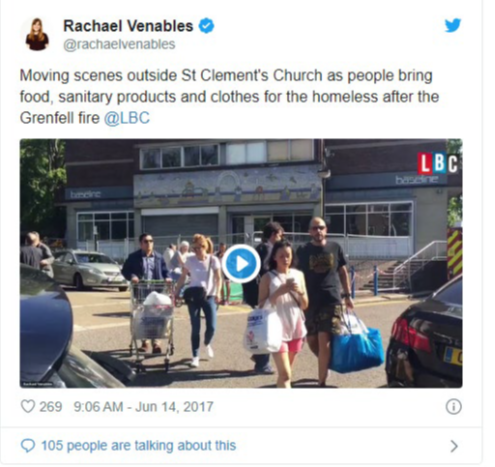
This was then picked up by an LBC reporter, below, who was able to film and share how people responded outside St Clements itself.
6. Including the social handles of local organisations means they can reshare your post too. Including hashtags, means your post will be grouped in all posts mentioning the same hashtag.
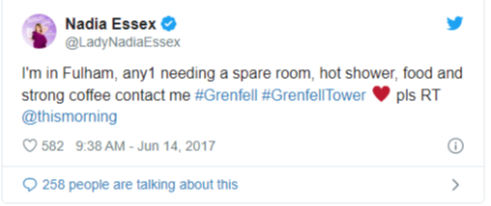
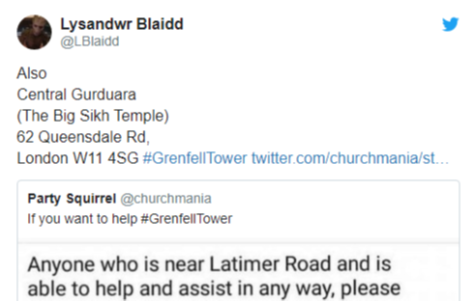
For example, the tweet below includes hashtags and asks for volunteers and directs people to places where help is needed.
Although the Instagram message, below from the chef Jamie Oliver, does not include hashtags and does not tag any other organisations, it is a clear
example of what help an organisation is offering and where it is directing people as to where they can receive support.
7. It is best to keep social media posts succinct. You can post a long form response on your website – an official place where people can find out more
detailed information, and link to it in your social media post, as seen in point five above.
8. Monitor the social media accounts of your local council, police and news so that you can be kept update to date as possible, so you can adapt your social media and the support you are offering.
Digital and accessibility considerations
In times of crisis, clear and inclusive communication is vital. Churches should ensure that all digital communications, both internal and external, are accessible, reliable, and appropriate for the situation.
1. Accessibility in digital communications
When posting updates on websites or social media, aim to make your messages as accessible and inclusive as possible. This helps ensure that
everyone, including people with disabilities, can engage with your content.
- Use alt text: Add short descriptions (alt text) to any images shared on social media so that people using screen readers can understand what’s
being shown. Example: “Photo of volunteers serving tea and coffee to local residents at the church hall.” - Include captions or subtitles: If you post video content (eg a short statement or prayer), use captions or subtitles so that people who are deaf or hard-of-hearing can follow along
- Keep language clear and compassionate: Avoid jargon and long sentences. Use calm, inclusive, and reassuring language
- Readable formats: Ensure documents, PDFs, or images shared online use large, high-contrast text and simple fonts (eg Arial 12). Avoid text
embedded in images whenever possible. - Accessible links: Instead of saying “click here,” write descriptive link text such as “Read our church’s latest community update.”
2. Internal digital communication
Quick and reliable internal communication is crucial during a crisis. Consider what channels your church team will use to share updates with each other.
- WhatsApp or other fast communication channels: Set up a small, private group for your Immediate Crisis Response Team (ICRT) to share updates quickly and confirm responsibilities. Keep it limited to key people to avoid confusion.
- Email and cloud sharing: For longer updates or documents, use email or a shared drive (eg Google Drive, Dropbox, or OneDrive). Make sure permissions are managed carefully to protect sensitive information.
- Data protection: Ensure any personal or sensitive information shared digitally (eg names of those affected) follows URC data protection and safeguarding policies. Avoid posting identifying information on public platforms.
- Digital security: Use strong passwords, update them regularly, and ensure that all key users have access to necessary accounts before a crisis occurs. Keep login details stored securely and shared only with authorised personnel.
- Business Continuity Plan: Make sure your Business Continuity Plan is kept up-to-date.
- That at least: two people have access to your church’s social media accounts.
- Your WhatsApp or internal communications group is tested periodically.
- Consider drafting a short “digital holding statement” template to be used in emergencies.
- Confirm that accessibility tools (captions, alt text, contrast settings) are available on your social media platforms.
- Make sure your website can be quickly updated by someone on your team.
Examples of holding statements (ideally issued within the first hour of a crisis):
General crisis:
“We are aware of an incident that has taken place in our local area. Our thoughts and prayers are with all those affected. The church is working with the relevant authorities and community partners to provide appropriate support. We will share further information once we have confirmed details. For the time being, we ask everyone to avoid speculation and rely on official updates from trusted sources.”
Church-related:
“We are aware of a situation involving [name of church] that has attracted public attention. The matter is being handled in line with United Reformed Church [safeguarding] and communications protocols. We will provide an update as soon as it is appropriate to do so. We ask for your prayers for wisdom, compassion and understanding for everyone involved.”
Community tragedy / local emergency:
“Our hearts are with everyone affected by today’s tragic events in [location]. [Name of church] is open for prayer and quiet reflection.
Tea, coffee, and pastoral support are available for those who need a place to gather. Updates about our opening hours and support activities will be shared here, and on our website [insert URL]. Please keep all those affected, and the emergency services, in your prayers.”
Tips for using holding statements
- Keep it brief (eg under 100 words).
- Avoid speculation or assigning blame.
- Update regularly as facts are confirmed.
Ensure consistency: share the same message across all platforms (social media, website, emails).
If your church has limited access to digital tools, consider appointing a partner congregation or Synod contact who can post updates on your behalf.
We will share further information once we have confirmed details. For the time being, we ask everyone to avoid speculation and rely on official updates from trusted sources.”
Handling the media on site
In the unfortunate event of a community tragedy, the media can show up at a church. Here’s how to handle them.
- Identify a location where reporters and photographers can park vehicles and stand while covering their story. This will prevent them having “free run” of your church property but also acknowledges that they have a job to do
- Don’t be afraid to create a “press free” zone by cordoning off an area and placing some hand-made signs. Journalists will respect this space (as it relates to privacy and harassment aka Clause 2 and Clause 3 of the Independent Press Standards Organisation). This would be better than throwing the media off your property, and enables you to create a relationship which may be beneficial to you in the future e.g. promoting a fundraising event to raise money for your church roof
- Designate a staff person to explain and enforce the boundaries
- Designate a staff person to log any queries posed by reporters. Make sure the following is logged:
- The reporter’s name
- The reporter’s telephone number
- The media outlet the reporter works for
- Information the reporter is seeking
- The reporter’s deadline
Providing a media briefing
Alternatively, you could speak to the media directly or read out a statement (ideally prepared in conjunction with the URC Communications Team)
- Keep the statement short and simple
- Use confirmed facts only that includes the basics of what’s happened and what the church is doing to respond. Do not give names of victims
- Express concern and compassion
- If reading a statement, don’t forget to look up and make eye contact with reporters. If you didn’t hear or don’t understand a reporter’s questions, ask them to repeat or clarify it
- You can pause before answering, or ask for a few moments so you can gather your thoughts
- Don’t guess or speculate, it’s okay to say “I don’t know, I can check on that”
- Conclude the briefing by saying something like: “I know you may have more questions, but that’s all I can say right now as I have to return to managing the situation and take care of the people involved.” You can then take business cards and provide an update later on
- As you have assigned roles to people, you can ask your admin support to publish the statement on your website and social media
Spokespeople and media interviews
A list of spokespeople available to speak on a range of subjects is outlined in The United Reformed Church Press Pack.
In the event of a local or regional crisis, the following people are appropriate for conducting media interviews, having agreed points of discussion with the ICRT and/or the ECRT:
- Church minister
- Synod Moderator. In the absence of the Synod Moderator, the Synod Clerk may be available.
In the event of a national crisis, the following people are appropriate for conducting media interviews:
- General Secretary
- General Assembly Moderator
In the absence of the above:
- Another member of the Senior Leadership Team
National or regional topical issues
- Any of the above mentioned, or Heads of a department may be available to carry out a media interview
- A church minister, local leader or Synod Moderator may also be available
Useful help numbers
Samaritans
Confidential support for people experiencing feelings of distress or despair.
Phone: 116 123 (free 24-hour helpline)
Website: www.samaritans.org
Cruse Bereavement UK
National charity for bereaved people in England, Wales and Northern Ireland.
Phone: 0808 808 1677 (Monday-Friday 9.30-5pm (excluding bank holidays), with extended hours on Tuesday, Wednesday and Thursday evenings, when it’s open until 8pm.)
Edinburgh Crisis Centre
Provides emotional support to callers.
Phone: 0808 801 0414 / Text 07974 429075 (24 hrs)
Email: [email protected]
Community Advice and Listening Line (C.A.L.L)
Offers a confidential listening and supportive service to the people of Wales.
Freephone 0800 132 737 or text help to 81066