
Local Ecumenical Partnerships
The term Local Ecumenical Partnerships (LEP) describes the situation where more than one Christian denomination is working together under a formal agreement. The URC is involved in around 400 LEPs; our most common partnerships are with the Methodist Church, the Baptists and the Church of England.
The Methodist Church is our closest ecumenical partner, with whom we share in approximately 300 LEPs. One hundred of these also comprise one or more additional ecumenical partners. There are 12 LEPs that include the Roman Catholic Church. A total of four congregations include the Moravian Church as partners; a further nine include the Salvation Army.
We have eight LEPs with the Church of Scotland. In Wales, LEPs exist with the Church in Wales, the Methodists, the Baptists, the Presbyterian Church of Wales and the Union of Welsh Independents.
The importance of LEPs
Approximately one-third of United Reformed churches are involved in LEPs. The URC’s 2022 General Assembly affirmed that “LEPs continue to be central to the ecumenical mission and vision of the URC”. The following year, a report from the Mission Committee to the 2023 General Assembly – Reinvigorating the Ecumenical Vision – noted the greater resilience and size of LEPs as compared with single-denomination local URCs:
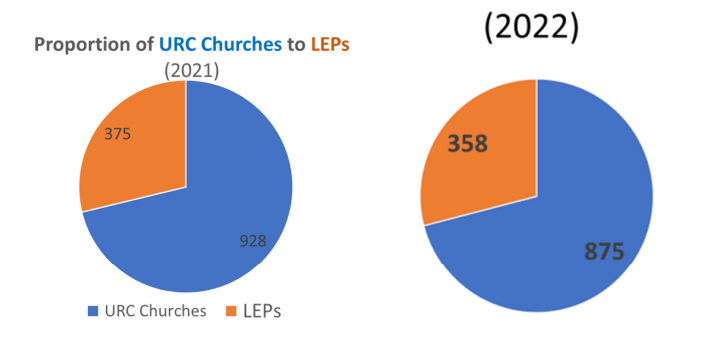
The report’s findings drew on the URC’s latest annual survey, for which 89% of LEPs (319 churches) submitted data. “This information shows that the numerical size of LEP congregations on average is larger than a single congregation local URC. They recorded 8,091 joint members, with an additional 3,666 people who identified their membership as purely URC (out of an overall LEP membership for this return of 18,357 members). Combining the joint and URC-only members (all of whom are full members of the URC) from the 89% of LEPs which provided information brings a total of just under 12,000 members. This is a substantial number, given the URC’s overall number of members.”
LEP documentation
LEP arrangements are necessarily individual to each setting and are established by means of formal documentation. This takes the form of a constitution or model governing document, and usually a sharing agreement, to take note of the original financial assets contributed by each denomination. In the URC, each individual synod oversees this detailed work and will generally nominate an ecumenical officer to help guide the process. There is a good deal of helpful guidance and associated documentation relating to LEPs available on the Churches Together in England (CTE) website.