

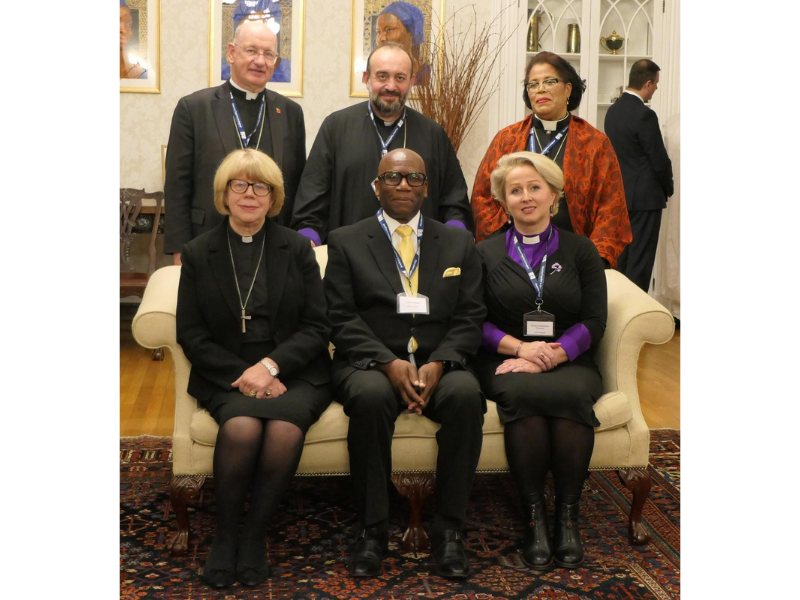
Churches Together in England held its annual dinner on 10 November at Lambeth Palace, hosted by the Archbishop of Canterbury.
At the dinner, the Revd Dr Tessa Henry-Robinson, a United Reformed Church minister who serves as Moderator of the Free Churches Group, delievered a speech which reflected on her time as one six Presidents of Churches Together England, which is as follows:
As the Free Churches President of Churches Together in England, I have had a number of opportunities to meet people, participate and gather ecumenically. Each experience has been welcoming and valuable.
I have had the privilege of joining colleagues at significant celebrations in the life of the wider Church, including installations and other occasions of importance to our Christian communities. These are moments when we recognise the different traditions through which we express our faith, while affirming the Christ who calls us together.
Again I attended the Remembrance Service at the Cenotaph, for me it’s always an experience that invites reflection on the human cost of war, the grief that continues across generations, and our responsibility as Christians to work for peace.
My particular concern for justice has shaped much of how I understand this presidency. There have been opportunities to lend my voice when members of God’s people have faced threats, violence or injustice. I believe the Church has a responsibility to speak in such circumstances. Our ecumenical commitment must have meaning in the lives of those who suffer. When one part of the body suffers, we are all called to attend to that suffering.
The words of Paul in 1 Corinthians 12, have accompanied my thinking about what it means to belong to one body. The passage speaks of the honour we owe to those whose place in the body may seem less prominent. And that the suffering of one member is shared by all. I find this a demanding understanding of unity, because it asks us to consider whose voices we hear, whose experiences shape our conversations, and whether we are prepared to stand alongside one another when doing so becomes difficult.
One of the particular joys of this role has been receiving invitations from member churches. I value these opportunities enormously. They allow me to encounter the different ways in which we worship, pray, understand our calling and live out our faith.
Friends we are similar in so many ways, but our differences are real. They arise from our histories, our theological convictions and the ways our communities have developed. There is much we can learn from each other, particularly when we listen with humility and allow our own assumptions to be questioned.
I am reminded of Jesus’ prayer in John 17, which reminds us that those who follow Christ may be one. I hear that prayer as an invitation to participate in something God is already doing among us. Unity is a gift, and a responsibility we are called to live.
I also want to say something about myself. I come to this role as a human being, someone who continues to learn, who has questions, who sometimes struggles, and who remains committed to growing in faith and understanding. I bring my experience, my convictions and my hopes, while recognising that there is always more to discover about God and about the people with whom I share this Christian journey.
Perhaps that is something I particularly want to communicate this evening. I am present, I am willing to listen, and I value the relationships that make our life together possible.
Towards the end of this month, I will be beginning a three-month sabbatical, which I am very much looking forward to. I recognise the importance of this time for rest, prayer, study and reflection.and remain attentive to any significant matters that may arise.
My sabbatical project is entitled Broken Hallelujah, a concept I have been thinking about since last year and which I hope to explore more fully over the coming months.
The title arises from my reflections on what it means to praise God while living with the realities of a wounded world. We know something of the brokenness of human life, within our communities, within the Church and in the wider world. There are times when praise comes easily, and other times when it emerges through grief, disappointment, uncertainty or struggle.
I am interested in what happens to our understanding of worship and faith when we take these experiences seriously. How do we sing our hallelujah while carrying sorrow? What does praise mean while injustice persists, when relationships are fractured, or the Church itself has caused pain?
These questions also belong to our ecumenical life. We are churches seeking to bear witness to the reconciling love of God, even as we continue to wrestle with our own divisions and failures.
For me, the resurrection of Christ gives us reason to continue this work. The risen Christ carries the wounds of crucifixion. Those wounds remain visible in the resurrection appearances, and I find something deeply significant in that. The suffering is remembered, and life continues in the presence of God.
I hope that my sabbatical will allow me to explore this understanding of praise more deeply, and perhaps discover something about the hallelujah that can still be offered when our lives and our world are wounded.
As I reflect on my time as President so far, I am grateful for the people I have met, the conversations we have shared and the ways in which I have been challenged and encouraged.
I look forward to continuing this journey with you, learning, and seeking together to be faithful to the calling we have received.
Image: Sarah Ball/Churches Together England.