

Assembly Executive (budget) 2026: round-up 24 November
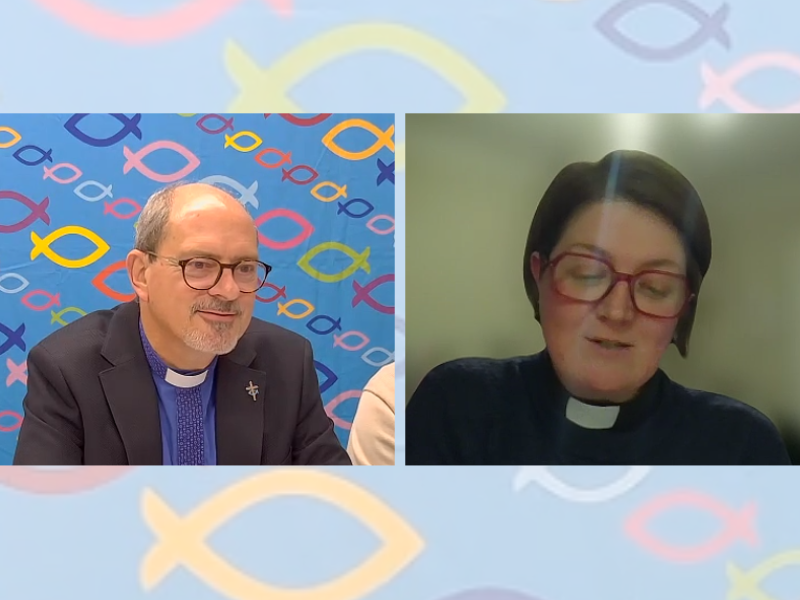
The Assembly Executive Budget Meeting 2026 took place online and at the Offices of General Assembly in London, on Tuesday 24 November. The Moderator was the Revd Neil Thorogood (below left)
Session 1
The Revd Irish Sirmons, Convenor of the Business Committee, welcomed Assembly representatives to the meeting.
Opening worship was led by the Revd Samantha Sheehan (below right). She reflected on the task of waiting and preparing ourselves for the coming of God’s kingdom. Discussions about budgets and processes can themselves help lay the foundations for what “might grow, move and live beyond”, she said. Samantha read from Psalm 95 and then led the meeting in prayer.
Session two
En bloc decisions
As with all meetings of the Assembly Executive and General Assembly, a number of matters were taken En bloc, meaning they were passed without debate. Representatives were sent the papers a few weeks before the meeting so they could be read, and resolutions taken out of En bloc if requested.
For the November 2026 Assembly Executive budget meeting, the En bloc decisions were:
Paper A1 – Moderator GA nominations Rules of Procedure amendment
The paper proposes amendments to the Rules of Procedure to clarify eligibility for nomination as Moderator of the General Assembly. It makes members of the Senior Leadership Team ineligible for nomination and introduces restrictions on individuals holding more than one General Assembly Officer role or combining these roles with membership of the Senior Leadership Team. It also sets out restrictions relating to the Assistant Clerk, Deputy Treasurer and Convenor of the United Reformed Church Trust.
Paper A2 – Scottish constitutions
This paper seeks approval for template constitutional documents for local churches in the National Synod of Scotland and to promote consistency in local church governance and the management of their charitable funds.
Paper C1 – Terms of Reference for the Ministries Committee
This paper seeks approval for the revised terms of reference for the Ministries Committee, giving it delegated authority to make minor and operational amendments to policies and processes within its remit without needing to refer each change to General Assembly. Substantive changes to policy or principle will remain subject to approval by Assembly Executive or General Assembly, as appropriate.
Paper C2 – Withdrawal of Call
This paper revises the framework for withdrawal of Call and establishes a clear, consistent and pastorally grounded process. It recognises the enduring nature of ordination or commissioning and a particular Call to serve in a specific context. It clarifies when competency or disciplinary processes should be used and when they are not appropriate in relation to when a pastoral relationship has broken down. It also sets out arrangements for local pastorates and transitional arrangements relating to stipend, housing and expenses following withdrawal of a Call.
Paper G1 – Nominations report
This paper appoints members of various committees and groups and external appointments following nominations and safer recruitment.
Paper O1 – Westminster Transition
This paper seeks approval to delegate authority to the Business Committee to appoint members of the governing body of Westminster College until 6 July 2028, and to make decisions on behalf of General Assembly and Assembly Executive where it is impractical to wait for a meeting of those councils to implement decisions already taken.
On a vote, the papers and their resolutions were passed by an overwhelming majority.
Paper D1 – 2027 Budget: Context and Assumptions Resources Committee
The Revd Dr Michael Hopkins, Convenor of the Business Committee, submitted the two draft resolutions (8&9) and invited Mr Alan Yates, the URC Treasurer, to speak to the paper.
Alan Yates said that the budgeted figures for 2027 show a deficit reduction of approximately £90,000 – the smallest for some time. The figures were better than expected, he said, mainly because some projected expenditures had not materialised, but also because of generous synod contributions and savings in operating costs. The plan for long-term deficit reduction may be working, he suggested, but he warned that “this is as good as it gets”.
The projected deficit of £300,000 for 2027 assume no change to synod generosity, little change in stipendiary ministry numbers, and no impact from recommendations to the M&M budget (the subject of the following paper on the agenda).
Alan offered a mnemonic to illustrate why future deficits are expected to increase: “4-3-2-1 economics”. He suggested that the although the mnemonic is only illustrative it does indicate “the structural environment in which the fund operates”:
Increased costs of c.3% and a 2%typical reduction in the number of URC churches each year, resulting in reductions in M&M income from the churches of 1%, leads to an annual deficit increase of 4% (currently estimated to be c.£750,000).
In answer to a question from Lorna Griffiths, Mersey Synod Clerk, the Treasurer clarified that the Church Life Fund is not included in the M&M figures because it sits in a separate, restricted, account. Anne Wood (Wessex Synod) was concerned about the travel and subsistence figures – why would they expected to rise sharply in the coming year but decrease in subsequent years when travel costs are rising? Mr John Samson, Chief Finance Officer, said that factors affecting this figure included a number of additional, one-off consultative gatherings and a universal increase of mileage costs to 55p a mile.
On a vote, Resolution 8 “Assembly Executive adopts the M&M budget for 2027”, was passed unanimously.
On a vote, Resolution 9 “Assembly Executive notes the trajectory for 2028 and 2029”, was passed unanimously.
Paper CD1 – Resolution 46 Task Group Criteria and Deliverables (Ministries and Resources Committees)
Myles Dunnett introduced himself as Director of Strategy and Programmes, and Convenor of the Resolution 46 Task Group, which is leading a review into the Ministry and Mission (M&M) Fund. Myles made four observations about the paper and resolutions.
- Myles said that bringing the paper forward now will allow sufficient time for the task group to establish recommendations and incorporate any changes before reporting to General Assembly in July. He emphasised that “what we are asking Assembly Executive to approve this evening is the framework for the decisions we will bring before General Assembly next July, not the decisions themselves”. Myles added that it was hoped the process being undertaken by the task group would have a positive effect on future budgets.
- Citing St Paul’s description of the Church as one body with many members (2 Corinthians), Myles said that the Ministry and Mission Fund is not simply a financial mechanism. “It is an expression of how we understand ourselves as a denomination: a conciliar Church, bound together in covenant, sharing responsibility for ministry and mission.”
- The paper’s six “deliverables” include proposals for (a) tangible changes to the funding mechanism to secure stability in the near term; and (b) sustained, properly resourced, denomination-wide work on stewardship and shared responsibility. “We believe these two things must go together.” The proposals are about “a renewal of our shared understanding of stewardship, the covenant, and what our collective resources make possible.”
- The task group has proposed ten criteria against which options will be evaluated, in order to provide a transparent and disciplined basis for discernment.
In questions for clarification, Myles responded to Jamie Laird (Wessex Synod) and Geoff Felton (Mersey Synod) by saying that the gathering of local church contributions for the M&M fund differs from synod to synod, so that there can’t be a one-size-fits-all approach to the synod mechanisms. However, he believed it is possible to develop principles behind M&M and its successor funds as a step to doing things in a more holistic way. He also confirmed that “near-term” changes to the funding mechanisms did not imply “temporary” but that, rather, such changes would ideally interconnect with the longer-term changes in the URC’s wider approach to stewardship.
Turning to general discussion, Geoff Felton encouraged the working group to have imagination and to emphasise “more” options rather than just one, in order for the General Assembly to debate choices. Myles confirmed that “a package of options” is likely.
Graham Jennings (East Midlands) suggested that an understanding of stewardship cannot be confined only to the giving of money – that it should encompass time and talents also; and Richard Lewney (Eastern Synod) added his hope that work on stewardship would suggest a positive attitude to giving in all its forms. Myles agreed that “we should be setting out a positive narrative for a stewardship campaign” and that our understanding of stewardship should be “cast widely”, encouraging both individual and corporate generosity (i.e. groups of trustees).
On a vote, Resolution 6, “Assembly Executive approves the recommended deliverables (5.1.1-5.1.6), and requests that the Resolution 46 Task Group brings outputs for each of these deliverables to Assembly in July 2027”, was passed unanimously.
On a vote, Resolution 7, “Assembly Executive approves and adopts the evaluation criteria in 6.2 for use in discerning which option(s) to bring before Assembly in July 2027”, was passed unanimously.
Session three
The meeting closed with prayer led by the Revd Samantha Sheehan.
Reporting: Laurence Wareing and Ann-Marie Nye