

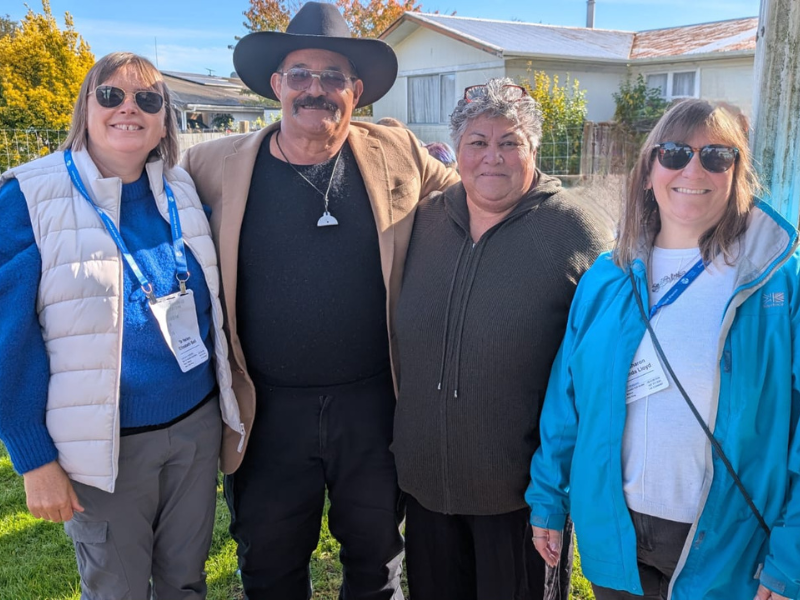
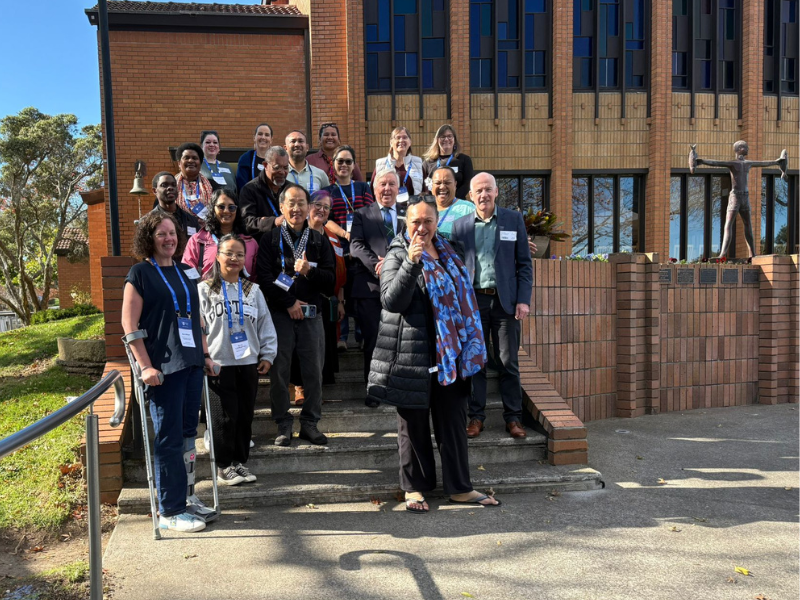
Leaders in children’s ministry and education from all around the world gathered in Auckland, Aotearoa New Zealand, in May to reflect on their varied experiences and traditions of faith formation for children.
The United Reformed Church’s Sharon Lloyd, Programme Officer (Children’s, Youth and Intergenerational Work), and Helen Bell, Mission Practitioner (Children) for the URC’s Eastern Synod were among the representatives in the ten-day programme organised by the Council for World Mission (CWM).
Guided by the Revd Dr Amelia Koh-Butler, CWM’s Mission Secretary for Education and Empowerment, the consultation examined how churches can renew Christian education for contemporary contexts while remaining rooted in faith traditions. There was discussion about inherited educational models, many of which were shaped by missionary approaches and systems developed in earlier eras and considered how these might be reimagined to better minister to children today.
With only one other participant from Europe, Sharon says that the experience of cultural diversity was an important takeaway from the event. There were leaders in children’s ministry and education from countries as far apart as Zambia and Hong Kong, India and Australia, Trinidad and Tahiti – and even from the world’s third smallest country, the tiny island of Nauru in the Pacific.
“I was very aware of how Sunday School teaching in some countries is still so influenced by white people who went there many years ago. We wanted to learn from each other, exploring how to cross the boundaries of countries and yet share traditions.”
She says the approach was to open up choice – “and to do this in a way that we were all asked to challenge ourselves. We can all stagnate in the way we do things.” Sharon adds that she was struck by the “broad range of storytelling, and how far storytelling can go amongst people of different cultures”.
Sharon says that meeting Māori people at a sacred dwelling (a Marae) in Ōhope, the Bay of Plenty, was especially formative. Learning about their rich indigenous traditions, including words of welcome that emphasised the importance of the land and of meeting in peace, made Sharon and Helen ask what was distinctive about their own British heritage.
It was in this context that Amelia Koh-Butler said, “it is necessary to examine and critique how our learning strategies embed colonial thinking and practice. To decolonise education, it is necessary to look at foundational learnings and strategies for formation.”
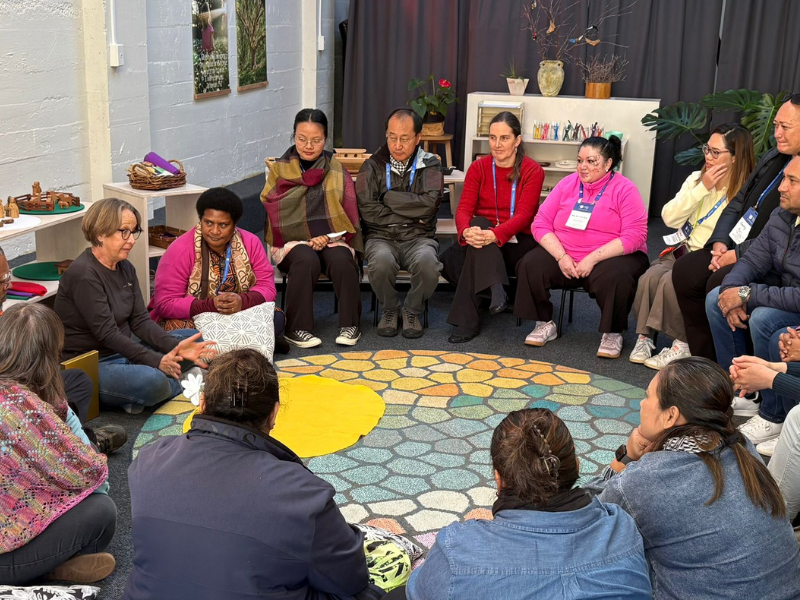
Many participants were encouraged by the commitment of teachers and facilitators who adapted lessons and learning methods to meet the needs of individual children. They noted that effective ministry with children depends not only on resources and programmes but also on strong relationships, consistent accompaniment, and a willingness to learn alongside young people.
Sharon and Helen say they came away with a renewed sense that children’s ministry isn’t just about educational techniques. “It is necessary to connect with children in order to encourage life-long relationships with God.” Intergenerational ministry was affirmed by all the participants, and together they expressed a shared desire to develop educational approaches that nurture faith, encourage participation, and equip children to flourish in a rapidly changing world.
Images: Main – the Revd Tamiana Thrupp, Moderator of te aka puahou Māori Synod of the Presbyterian Church of Aotearoa New Zealand, and Honey Thrupp (centre), with Helen Bell and Sharon Lloyd; in article – participants outside a Presbyterian Church school, and in a group session.