

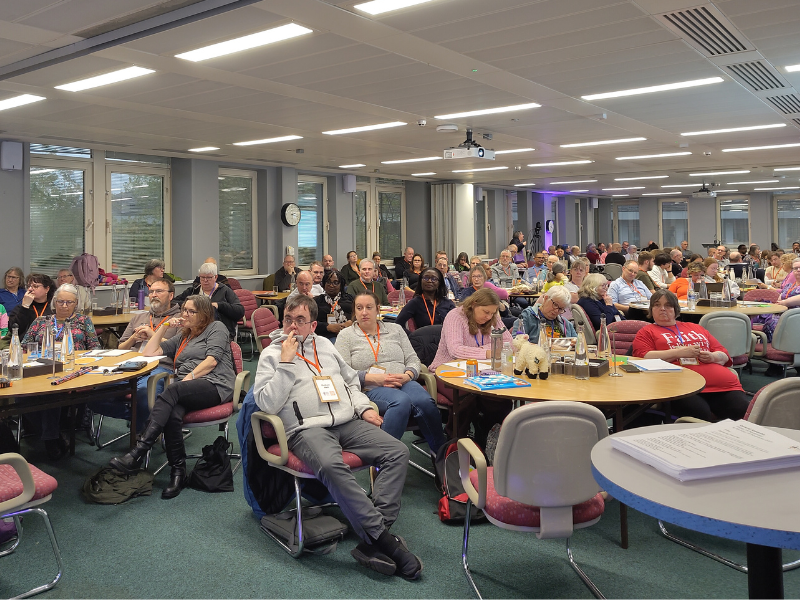
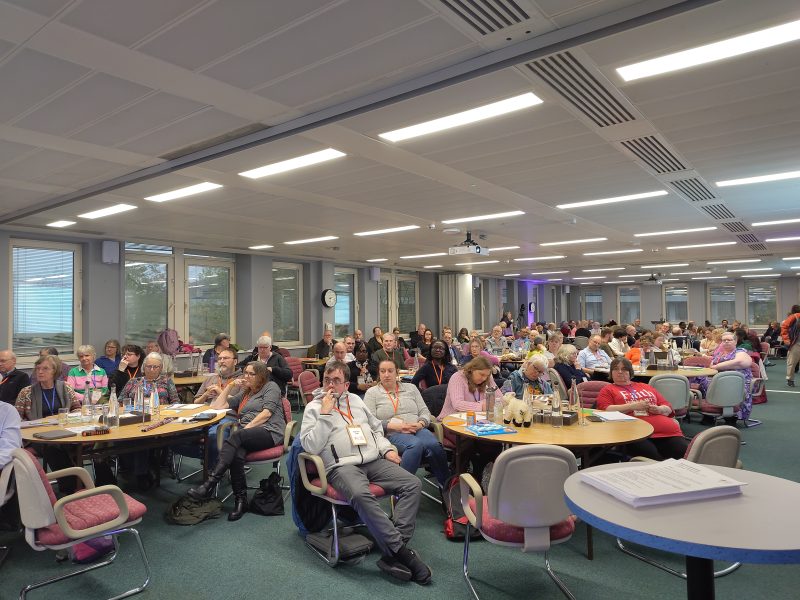
An Extraordinary Meeting of the United Reformed Church General Assembly opened at Kents Hill Park Training and Conference Centre in Milton Keynes on 14 November 2025.
Opening Worship and introductory session
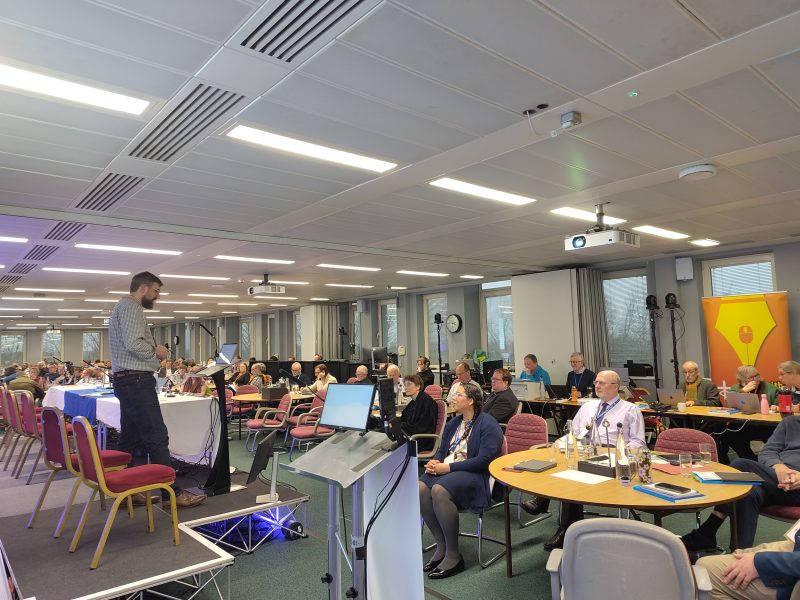
General Assembly opened with worship, led by the Revd Jane Wade, Chaplain to the Moderator. The Revd Richard Byass, a Methodist Superintendent in Nottingham (pictured), spoke on the opening of St Paul’s letter to the Philippians, concluding that it was the job of Assembly to discern the message of hope for the URC.
Apologies for absence were received from the Revd Kim Money, Moderator of the Northern Synod. She is remaining within her Synod to support the congregations and communities affected by recent news from the region, highlighted in a recent report from the Prisons and Probation Ombudsman.
The Moderator’s Chaplain led Assembly in prayer for those affected.
The Revd Dr John Bradbury, General Secretary of the URC, gave a presentation looking back on the story of Church Life Review (CLR), starting in 2021 with a call for people to share their experiences, hopes and fears about church life. This was accompanied by focused research into who the URC are, and forensic accounting, which raised questions but showed we had some financial resources.
What emerged, said Dr Bradbury, was the picture of a Church in which small congregations make an oversized difference to their communities, but are deeply tired and scared of running out of people. It is a Church with an oversized centre. It is a Church wary of evangelism.
As a result, in 2023 General Assembly passed resolutions initiating work to find ways to reduce the burden of compliance, to explore the ideas of a resources hub and shared services. CLR would also look for ways to resource employed local lay workers and enable new communities of worship and discipleship to emerge. It would look into reducing the committee structure and central staff team.
Dr Bradbury paid tribute to the work of Myles Dunnett as Programme Manager, supporting the Steering Group as it consulted and developed concrete proposals which are now before Assembly.
Our Church continues to face decline, he said, but also faces a moment of opportunity in our society.
“The proposals that come to this General Assembly are a faithful attempt to offer a response to what we have heard the Church say it needs. We believe they will equip us for the next stage of the journey together as the United Reformed Church. But we are under no illusions that this is the whole solution to the challenges we face…
“Far more is called of us that when we can decide this weekend. For that reason, extraordinarily, this General Assembly is not only being asked to discern a set of resolutions, we are also seeking to discern together what comes next.”
He concluded: “My prayer is for the movement of the Holy Spirit among us. I believe there is a Kairos moment in the life of the Churches in this part of the globe. Something is changing around us – something which opens up new possibilities. I believe that in our discernment together this weekend, the foundations might well be laid for the next stage of our journey together as the United Reformed Church that will enable us to respond faithfully to the call of God, who is holding before us a moment of promise, opportunity, and hope.”
Paper A1 – Church Life Review Phase Two Proposals
Myles Dunnett, the Church Life Review Programme Manager, introduced Paper A1, which set the frame for the package of proposals presented in the Book of Reports. He advised that the paper was less a routine policy update, but more a significant moment of collective discernment about how the URC will live and serve in the years ahead. He said the programme’s core aim has been consistent: reducing the burdens on local churches so they can focus more fully on mission and ministry in their place.
The steering group, at the centre of phase two’s work, has been working to realise a vision of a more flourishing Church, less burdened and better enabled.
Throughout the process, the CLR has intentionally followed a collaborative, conciliar approach, listening widely across the Church over the past five years. Grounded by the words of Jeremiah 29:5-7, the programme has encouraged the Church to work together with hope, seeking the welfare and flourishing of the whole Church.
Paper A1 contains four key resolutions applying across the programme’s four workstreams: financial resource sharing, shared support services, employment of lay workers, and new communities of discipleship and worship.
- Resolutions 1a and 1b invited Assembly to acknowledge the amount of work and discernment undertaken, naming this as a Kairos moment that God has given us; a time for decisive denominational action. Mr Dunnett explained that one important lesson from the Review is that, notwithstanding the role of Assembly, the URC has lacked forums where key stakeholders can come together to explore challenging strategic questions in an open, facilitated, collaborative space.
- Resolution 2 therefore asked Assembly to commit to a denominational intention to continue ad-hoc consultations, allowing people from across the councils to collaborate and discern future strategy together.
- Resolution 3 proposed a model where resources and services are created together at a denominational level but delivered locally to reduce duplication and improve access.
- Resolution 4 encouraged committees to strengthen the use of data in decision-making, ensuring choices are not only faithful but also well-informed.
Together, Mr Dunnett said, these resolutions offered a framework for a more collaborative, strategic, and evidence-informed future, attentive to both the Gospel’s call and the realities of local church life.
Following the presentation of Resolutions 1a to 4 to the Extraordinary General Assembly, the floor opened for questions of clarification and discussion.
Resolution 1a carried and 1b carried.
The Revd Susan Durber opened a discussion around Resolution 2 and the use of the word “relevant”, whether it excluded rural churches for instance, advising that they are equally important to discussions, although she noted that in small churches in rural Wales it has been difficult to encourage conversations about the CLR process. Myles explained that the use of the word “relevant” was meant to reference relevance within the context of any given discussion topic, but accepted the point that conversations need to include the length and breadth of the denomination, which has been the CLR’s aim.
Another speaker said the word “relevant” was important as there are particular constituencies that need to discuss particular things; that it was down to those constituencies to take steps to enable wider discussions.
Following further discussion, a vote was then held about the removal of the “relevant” from the resolution which was carried.
Resolution 2 was carried.
Concerns were expressed around Resolution 3 and how it would be communicated to local churches, who might feel dictated to. Would the resolution stop local innovation? Was it necessary at all considering that such services and resources might be in place locally already?
Mr Dunnett explained that he hoped that these concerns would be addressed in Paper A10, and rather than preventing local innovation, the desire was actually to enable better local innovation; to ask what can be done at a denominational level to support local efforts.
Resolution 3 then carried.
Thoughts were then expressed about Resolution 4: what data would be collected and for what reasons? Data collected needed to be specific to the URC and its way of doing mission. Concern was expressed about the burden would be placed on local church secretaries. John Bradbury, General Secretary, explained that only necessary information would be sought and that the goal would not be to burden local church secretaries. Mr Faber added that the purpose was not to gather data for gathering data’s sake but to discern the mind of Christ for the URC.
Resolution 4 carried.
Papers A2/A11 Proposal to establish a shared Church Life Fund / Size of the Church Life Fund
The Revd Steve Faber, Convenor of the Church Life Review (CLR) Steering Group, introduced two papers that underpinned the financial underpinning of the Church Life Review’s goals. Paper A2 proposed the creation of a Church Life Fund (CLF), with a built-in review of its initial financial position. He said a proposed common fund would finance the other pieces of work to be considered later in the meeting.
Resolutions 5 to 11 set out the legal, structural, governance, and operational framework for the Fund. They would establish it as an expendable restricted fund within the United Reformed Church Trust, with an initial lifespan of ten years. Mr Faber said the Fund would ensure “high standards of trust, transparency, and compliance, building on existing structures and processes, as well as what has worked in the past”.
He argued that the CLF will only work if it is jointly owned, and he emphasised the need for synods and local congregations to be integrally involved in the management of the Fund, allowing its use to be informed by imagination, local knowledge and local context. Resolution 9 would invite Assembly to instruct the Committee to publish criteria to support synods in deciding when and how to make applications to the Fund. He added that though it will be resourced primarily through the generosity of synods and their trust companies, thought would be given to how local churches, individuals and external bodies might also contribute in.
Mr Faber announced that following consultations within the 13 individual synods, the expectation is that the Fund will have an expenditure of £3m per annum over its first three years, up to the major review of the fund. He said it was important to recognise the scale of the shared commitment that has made the Fund possible. He said, “Every contribution means more lay workers and new communities can be funded, more ministers and elders freed from back-office administration to serve in mission, more members released to share the Gospel, and more people encountering the living God in places we don’t currently reach.” If people are not released from institutional work so that they can engage in the front-line mission of the Church, he said, then the Church Life Fund will not be meeting its overarching objective.
In answer to questions, Mr Faber said the CLF will define the criteria by which grants are made, and that if issues such as anti-racism and anti-poverty were being addressed in ways congruent with the lay worker or new community criteria, such proposals could be submitted.
He said applications could potentially be from groups other than a church congregation within the shared services funding stream. To avoid the risk of money drying up prior to the conclusion of a funded project, the cost of the project must be fully absorbed in the year the grant is made.
How will local knowledge and discussion be accessed and heard? asked another speaker. Mr Faber said: through the work of the synods putting forward applications sourcing and passing on local knowledge to the CLF. He also confirmed that the CLF will not replace the inter-synod sharing process, which is about annual budgets. What about fruitful ongoing work? asked a synod Moderator. Mr Faber said that if existing work met the criteria, it could be the subject of an application. However, he emphasised that the Fund is finite and couldn’t fix all local funding issues.
Resolution 5 endorsing the establishment of the CLF was carried unanimously.
As some synods have already made a three-year financial commitment, Romilly Micklem proposed amending Resolution 6 to require a review of the CLF after two years of operation, not three. This would be a review of the Fund, not the ongoing work being funded. Accepting the amendment, Mr Faber said the review would be in the third year of the Fund’s operation and this would inform synods’ decisions about whether to re-commit to further funding. The review would be carried out independently of the CLF committee and so wouldn’t distract from the core work of the committee. It was also agreed that a report on outputs of the review will be brought to the first available Assembly following the review.
Resolution 7 confirmed the terms defining how contributions would be made by synods to the CLF, and the Fund’s purposes. In response to a question, the General Secretary said that this resolution provided deliberately broad criteria as required by charity law. Further details would be provided elsewhere. The Legal Advisor agreed. There was further discussion around what constitutes a lay worker or a local church, and Mr Faber indicated that in drawing up the Fund’s criteria, sympathetic consideration would be given to a range of possible scenarios.
Resolution 8 addressed the make-up of the Church Life Fund Committee, to include representatives from each synod. In answer to concerns about the role of Nominations Committee in the process of choosing synod representatives, assurance was given that conversations with Nominations would focus on ensuring wide representation, bearing in mind e.g. skills, diversity, and age-range.
Resolution 9 established the need to publish criteria against which judgments about applications would be made. Resolution 10 noted draft terms of Reference; and Resolution 11 confirmed a desire to explore ways in which individuals, local congregations and others can contribute to the fund.
Resolutions 7 to 11 were all passed.
Turning to paper A11 and resolution 48, gratitude was expressed for the indicative offers of donations to the CLF from synods and synod trust companies.
Paper A3 – Resources Hub
General Assembly agreed to the launching of the shared resources hub, provisionally entitled myURC, and a helpdesk.
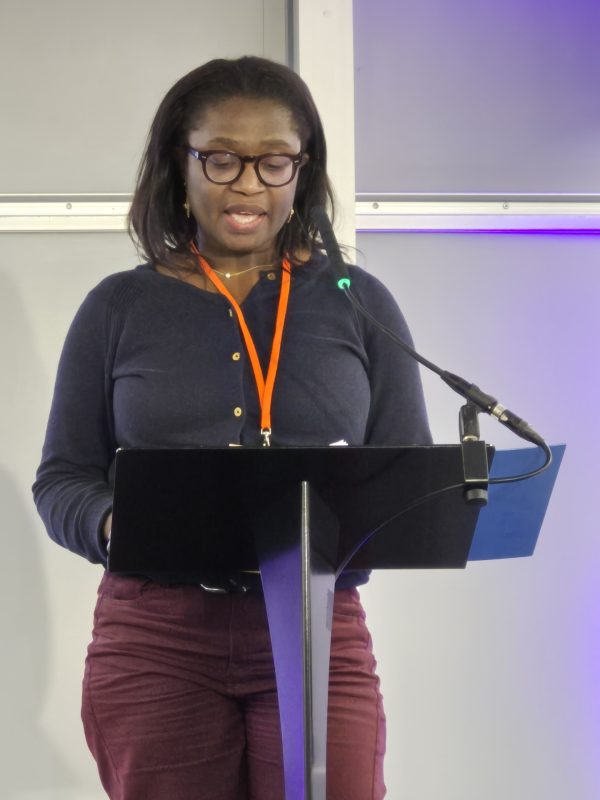
Presenting the proposals to Assembly, Muna Levan-Harris of the CLR Steering Group said that the group had found that churches and synods spend vast amounts of time looking for the same information, filling the same forms, and answering the same questions. She said, “myURC is designed to change that, by creating a single, trusted, well-governed place where everyone in the URC can find the policies, templates, and guidance they need to run their local church safely, confidently, and compliantly.”
Myles Dunnett, CLR Programme Manager, told Assembly that the project was still in development, so not all questions could be answered yet.
It emerged in discussion that Assembly was enthusiastic about the proposed website, but not convinced about the name ‘myURC’. Rather than trying to resolve this question at Assembly, it was agreed that the name would be reconsidered later.
The following points were also addressed by the Steering Group in response to questions from members of Assembly:
- A glossary of acronyms and other obscure terms will be included.
- Resources will be accessible through e-readers.
- We do not yet know whether the proposed chatbot will be coded or AI.
- Conversation has taken place with ecumenical partners and collaboration will continue, but we need our own branded services to ensure people know they can get URC-specific advice.
- Those responsible undertook to look into making the helpline available outside working hours, but noted that this would have implications.
- They also noted that it would be valuable to offer IT support and advice on cyber security, but we need to manage expectations.
Assembly passed all six resolutions attached to this paper.
Evening prayer
The Revd Jane Wade led Assembly in a closing Examen prayer and the Assembly adjourned for the evening.